October 20, 2026 12:30 pm (IST)

Follow us:


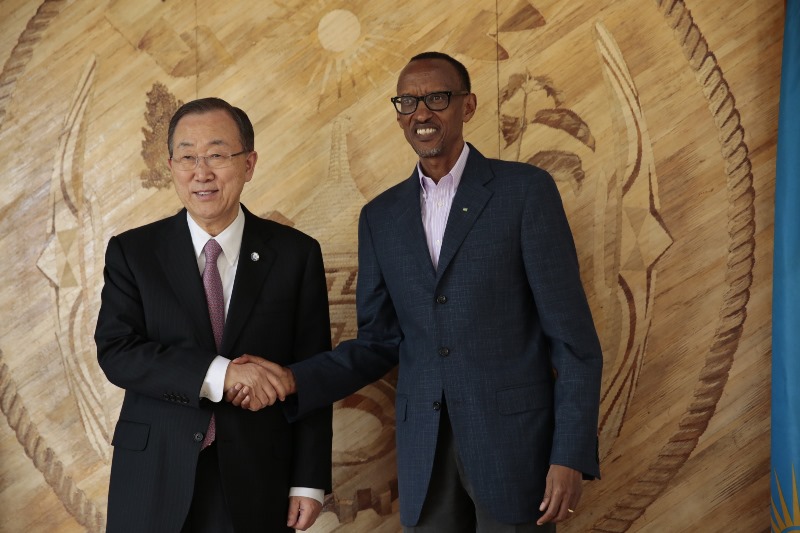
Rwanda: Ban urges global support to prevent future atrocities
New York, Apr 7 (IBNS): As Rwandans commemorate the genocide that took place 20 years ago, United Nations Secretary-General Ban Ki-moon stressed during a visit to Kigali on Sunday the need for the international community to learn from such atrocities and to ensure that the words 'never again' are translated into action.
Ban is in Rwanda to participate in Monday's official commemoration of the genocide, during which at least 800,000 ethnic Tutsis and politically moderate Hutus were killed in 1994 during three months of bloodletting that followed the death of the then-president Juvenal Habyarimana.
Speaking at a joint press encounter on Sunday with President Paul Kagame, the Secretary-General said he would use the occasion to reaffirm the international community's “strong commitment” to ensure that such horrors do not occur again.
“This should never happen in human history,” he told reporters, referring to the genocide. He underscored the need to use the “tragic and hard lessons” from the horrors that took place in both Rwanda in 1994 and Srebrenica in 1995 to ensure that such atrocities never happen again.
In a related op-ed published on Sunday in The Independent (UK), the UN chief said that the genocides in Rwanda and Srebrenica were “emblematic failures” of the international community, and while the world has made important strides since those tragic events, more must be done.
“The international community cannot claim to care about atrocity crimes and then shrink from what it actually means to prevent them. Global leaders should do more to prevent the preventable, and to counter the cruelty taking place before our eyes,” Ban wrote.
“People everywhere should place themselves in the shoes of the vulnerable, from Syria to the Central African Republic, and ask themselves what more they can do to build a world of human rights and dignity for all. Let us show people facing dire threats that they are not alone or abandoned – and that the lifeline they need is on its way,” he said.
Monday's commemoration in Kigali is part of a series of events known as 'Kwibuka 20,' whose theme is 'Remember, Unite, Renew'.
The events aim to remember the people murdered in Rwanda, draw inspiration from the ability of the Rwandan people to unite and reconcile, and marvel at their determination to renew their country.
(Secretary-General Ban Ki-moon with President Paul Kagame in the Rwandan capital, Kigali, on 6 April 2014. Photo: UN/Evan Schneider)
Support Our Journalism
We cannot do without you.. your contribution supports unbiased journalism
IBNS is not driven by any ism- not wokeism, not racism, not skewed secularism, not hyper right-wing or left liberal ideals, nor by any hardline religious beliefs or hyper nationalism. We want to serve you good old objective news, as they are. We do not judge or preach. We let people decide for themselves. We only try to present factual and well-sourced news.
Support objective journalism for a small contribution.

Latest Headlines
India–New Zealand free trade agreement takes effect on October 20
Mon, Oct 19 2026
Ecuador: Priest dies after giant crucifix falls on him during mass, video goes viral
Sun, Oct 18 2026
Planning a Bali trip? Fuel shortage triggers odd-even rule, Indian tourist shares nightmare
Sat, Oct 17 2026
Air France bans Pakistani pilots from Israel flights after security crackdown; United Airlines follows suit
Wed, Oct 14 2026
flydubai cockpit attack probe widens: Two Maldivian pilots detained in UAE over links to Omani co-pilot
Wed, Oct 14 2026