Returning from Mali, senior UN relief official spotlights country's complex challenges
“Nearly two years after the signing of a peace agreement, Mali is again at a critical turning point with devastating implications for its people and the region,” said the Director of Operations for the UN Office for the Coordination of Humanitarian Affairs (OCHA), John Ging, in New York, upon his return from the African country.
“We must meet the immediate humanitarian needs, strengthen resilience, empower Mali's women, invest in children's education, and reopen schools before this generation is lost to the conflict.”
According to estimates, nearly one in five Malians are in need of humanitarian assistance this year, and 3.8 million people are could face food insecurity in the coming lean season as violence reduces access to land. Malnutrition rates are also on the rise due to decreased access to food and the country now exceeds the alert threshold for global acute malnutrition.
Furthermore, deteriorating security in central Mali since February has displaced more than 10,000 people and some 507 schools have been closed across the country's central and northern parts, impacting about 150,000 children. This is 70 per cent more schools closed than at the same period in 2016.
The conflict has created a humanitarian crisis caused and people are cut off from access to basic services, including water, health and education, prompting an intensification of needs.
At the same time, concerted efforts are needed to address the particularly alarming situation of Malian women. According to OCHA, almost nine in ten women and girls in the country between the ages of 15-49 have been subjected to female genital mutilation.
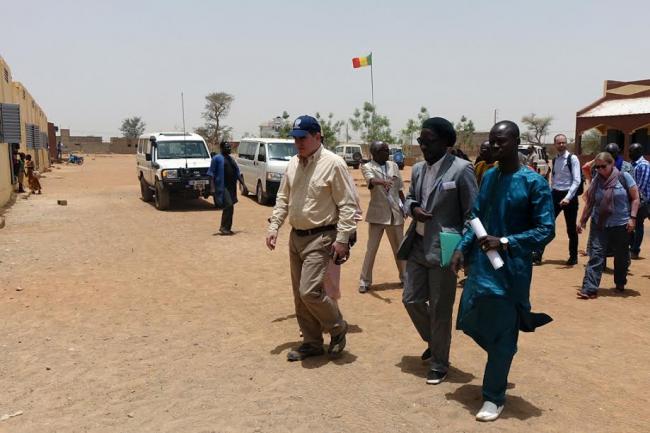
Accompanied by several key donors, the senior OCHA official visited several locations in the country and met with officials, visited health and nutrition centres and schools.
In Mali, Ging also met with Prime Minister Abdoulaye Idrissa Maiga, emphasizing the need for a comprehensive response to tackle growing challenges in the country. He also encouraged the Government to engage more closely with affected communities and work to re-establish basic services.
“The focus and support for the security sector alone will not solve Mali's crisis,” said Ging after his mission.
“The key is to support and empower the people of Mali […] as an international community, we must intensify our engagement,” he added, urging the global community to sustain and increase its funding for programmes in the country.
Funding for aid programmes in Mali has seen a steady decline and the $293 million Humanitarian Response Plan for 2017 is only 11.6 per cent funded.
Photo: OCHA/A.Desgroseilliers
Source: www.justearthnews.com
Support Our Journalism
We cannot do without you.. your contribution supports unbiased journalism
IBNS is not driven by any ism- not wokeism, not racism, not skewed secularism, not hyper right-wing or left liberal ideals, nor by any hardline religious beliefs or hyper nationalism. We want to serve you good old objective news, as they are. We do not judge or preach. We let people decide for themselves. We only try to present factual and well-sourced news.
Support objective journalism for a small contribution.