Partnerships, fresh policy ideas needed to ensure ‘no one is left behind,’ UN Asia-Pacific forum told
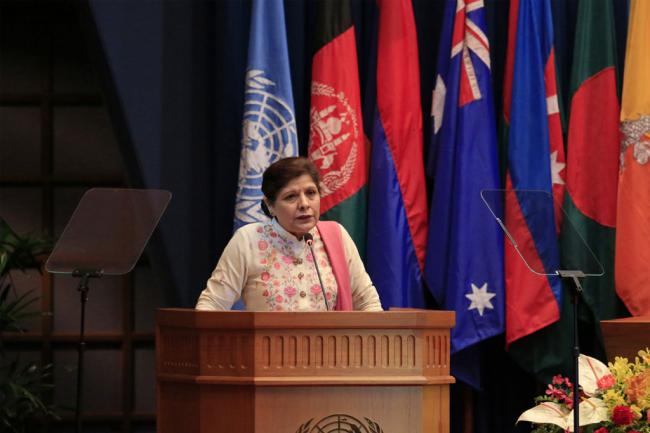
“Comprehensive implementation of the 2030 Agenda for Sustainable Development requires partnerships and deployment of new solutions between countries and across subregions,” said Shamshad Akhtar, the Executive Secretary of the UN Economic and Social Commission for Asia and the Pacific (ESCAP), which opened its 72nd session in Bangkok on Tuesday.
“The 2030 Agenda calls for fundamental policy rethinking, and shifts in action, for which pacing and sequencing of national initiatives will be critical,” she said, also highlighting the crucial role of regional cooperation and connectivity, noting that appropriate pacing and sequencing of regional cooperation holds the potential to reinvigorate growth and shared prosperity through diversification, inclusiveness and sustainable development.
“Smart development demands that we move from silo-bound to cross-sectoral approaches and solutions, deploy the right mix of policies and incentives and address cross-cutting and thematic areas such as tackling all types and sources of inequality,” added Akhtar.
The 72nd session is being held under the theme ‘Science, Technology and Innovation (STI) for Sustainable Development,’ and places particular emphasis on harnessing STI towards achieving the 2030 Agenda in Asia-Pacific.
ESCAP’s new theme study proposes shifting STI policy to focus on supporting social justice and environmental protection; resource efficiency; integrating openness and inclusivity into innovation strategies; and the promotion of technology to support quality jobs and reduce environmental impact.
In a written message to the Commission, UN Secretary-General Ban Ki-moon stressed: “We are living in a crucially important period for humanity. Last year the leaders of the world adopted the 2030 Agenda for Sustainable Development, along with the Addis Ababa Action Agenda and the Paris Agreement on climate change. But the delivery of our crucial mandate starts from this year. We have the collective responsibility to turn these landmark agreements into tangible actions now.”
The Prime Minister of Fiji, Josaia Voreqe Bainimarama, outgoing Chair of the session, highlighted the commitments made by the international community to the 2030 Agenda, the Addis Ababa Accord, the Sendai framework, and most importantly for Fiji, the Paris agreement on climate change. The Prime Minister said the biggest challenge now is to implement these agreements, and he underlined that ESCAP has a very important role to play in meeting that challenge.
The Prime Minister of Tajikistan H.E. Qohir Rasulzoda, who was elected to Chair of the session added that ESCAP serves as a unique intergovernmental platform and the members of ESCAP shall work hand in hand with the Secretariat to promote truly inclusive and sustainable development in the Asia-Pacific region.
Photo: ESCAP
Source: www.justearthnews.com
Support Our Journalism
We cannot do without you.. your contribution supports unbiased journalism
IBNS is not driven by any ism- not wokeism, not racism, not skewed secularism, not hyper right-wing or left liberal ideals, nor by any hardline religious beliefs or hyper nationalism. We want to serve you good old objective news, as they are. We do not judge or preach. We let people decide for themselves. We only try to present factual and well-sourced news.
Support objective journalism for a small contribution.