Paraguay: UN chief says 2015 crucial for international community
Delivering remarks to the National Congress of Paraguay earlier on Thursday, the Secretary-General reminded those gathered that the international community continues to face “big global challenges” in addressing inequality and insecurity, deepening democracy, enhancing the quality of education, and respecting and protecting the rights of all regardless of gender, ethnicity, culture, religion or sexual orientation.
“Now is our moment to take on these challenges. The year 2015 presents a once-in-a-generation opportunity for people and our planet,” Ban declared.
He added, “We are the first generation that can end poverty. We are the last generation that can avoid the worst effects of climate change.”
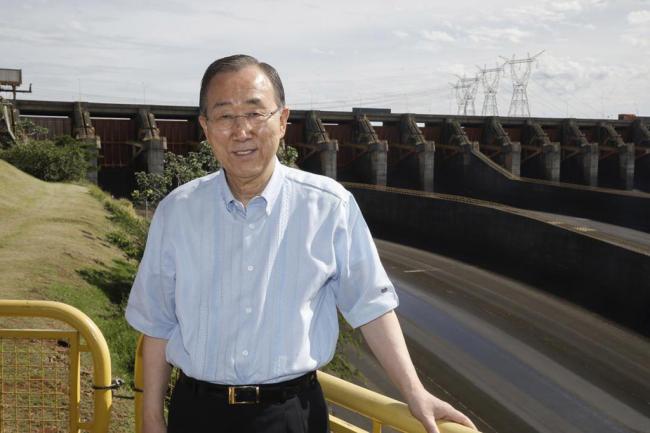
Ban’s remarks come as he continues his week-long trip to the South American country, including official visits in the capital of Asunción and to the critical Itaipu Hydroelectric dam which supplies up to three-quarters of Paraguay’s energy needs.
This year marks the end of implementation of the landmark UN Millennium Development Goals (MDGs), which world leaders agreed on 15 years ago in an effort to tackle poverty and climate change and to pave the way towards a more gender equal global society.
The new targets, to be known as the sustainable development goals (SDGs), are defining the way forward on the world’s most pressing issues until the next critical deadline in 2030.
Overall, there has been significant progress in meeting the MDG targets. Global poverty has been halved well ahead of the 2015 deadline; in developing countries, 90 per cent of children now enjoy primary education; the number of people lacking access to improved drinking water has halved; and the fight against malaria and tuberculosis has shown results.
Nonetheless, numerous challenges persist. Globally, 73 million young people are looking for work and many more are trapped in exploitative jobs. In recent years, more than two and a half million more children in affluent countries fell into poverty, bringing the total above 76 million.
In addition, Ban noted that despite efforts to reduce gender inequality, “gaps between law and practice” remained.
The scheduled meeting on the SDGs coupled with the major climate conference to be held in Paris in December has made 2015 a “pivotal year” for the international community, the Secretary-General continued, particularly as Member States face down an ever-growing list of threats and crises, from the “continuing bloodshed in Syria, tumult in Ukraine, Ebola disease in Africa.”
“Intolerance is growing. And violent extremism is rising. No country or organization can defeat terrorism and extremism on its own,” he added.
“All countries, along with regional and international organizations as well as political, religious, academic and civil society leaders, should join hands together to forge a multi-faceted response that respects international human rights and humanitarian law.”
Photo: UN Photo/Evan Schneider
Support Our Journalism
We cannot do without you.. your contribution supports unbiased journalism
IBNS is not driven by any ism- not wokeism, not racism, not skewed secularism, not hyper right-wing or left liberal ideals, nor by any hardline religious beliefs or hyper nationalism. We want to serve you good old objective news, as they are. We do not judge or preach. We let people decide for themselves. We only try to present factual and well-sourced news.
Support objective journalism for a small contribution.