


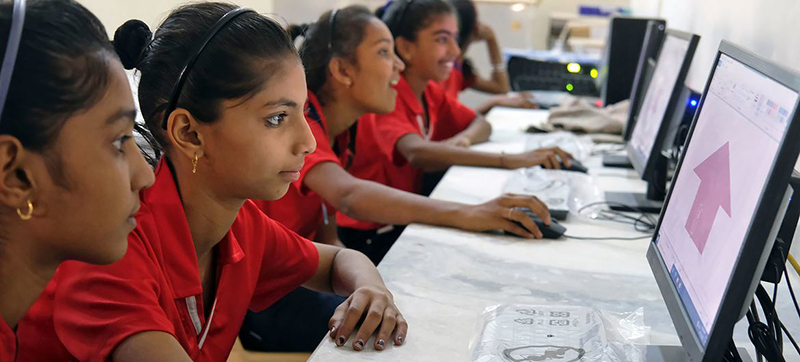
 adolescent girls
New report shows 90 per cent of adolescent girls in low-income economies are offline
Around 90 per cent of adolescent girls and young women do not use the internet in low-income countries, while their male peers are twice as likely to be online, according to a new UNICEF analysis, coinciding with the UN’s International Girls in ICT Day.
"Closing the digital divide between girls and boys is about more than just having access to the internet and technology. It's about empowering girls to become innovators, creators, and leaders," said UNICEF Director of Education Robert Jenkins.
"If we want to tackle gender gaps in the labour market, especially in Science, Technology, Engineering and Math fields (or STEM), we must start now by helping young people, especially girls, gain digital skills."
Soundcloud
The report, Bridging the Digital Divide: Challenges and an Urgent Call for Action for Equitable Digital Skills Development , takes a close look at the gender digital divide among young people aged 15-24.
It crunches the data on internet use, mobile phone ownership, and digital skills in mostly low, lower-middle, and some middle-income economies. Though more data is needed to better monitor, understand, and work toward digital inclusion, the report finds that girls are being left behind in an increasingly digital and connected world.
Skills deficit
While advancing access to the internet is important, it isn’t enough to boost digital skills training. For example, in most countries analysed, the number of young people with access to the internet at home, is much higher than the number of youths who have obtained digital skills.
Girls are the least likely to have the opportunities to develop the skills needed for 21st century learning and employment, according to the report.
On average across 32 countries and territories, girls are 35 per cent less likely than their male peers to have digital skills, including simple activities like copying or pasting files or folders, sending emails, or transferring files.
Phones for the boys
The report suggests that educational and family environments play a critical role in the gender digital divide.
For example, even within the same home, girls are far less likely than boys to access, or be able to make full use of the internet and digital technologies. Across 41 countries and territories included in the analysis, households are much more likely to provide mobile phones for boys than girls.
Barriers to accessing opportunities to higher learning and the labour market, pervasive discriminatory gender norms and stereotypes, and concerns over online safety, may further restrict girls' digital access and skills development, said UNICEF.
To break through the barriers, they need early exposure and access to technology, digital and life skills training, that also helps neutralize the impact of harmful gender stereotypes, especially within families, and online violence.
Support Our Journalism
We cannot do without you.. your contribution supports unbiased journalism
IBNS is not driven by any ism- not wokeism, not racism, not skewed secularism, not hyper right-wing or left liberal ideals, nor by any hardline religious beliefs or hyper nationalism. We want to serve you good old objective news, as they are. We do not judge or preach. We let people decide for themselves. We only try to present factual and well-sourced news.
Support objective journalism for a small contribution.


