Neal Katyal slams Trump’s 15% global tariff, says President cannot bypass Congress
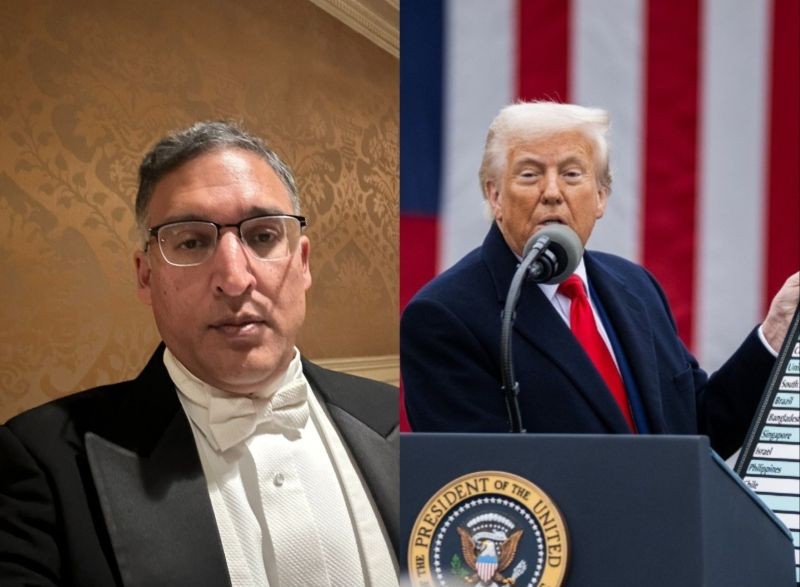
Indian-American constitutional lawyer Neal Katyal has strongly criticised Donald Trump for imposing a 15% global tariff, arguing that the US President cannot bypass Congress when introducing sweeping trade measures.
Katyal said that if Trump believes the tariff is justified, he must follow constitutional procedures.
“If he wants sweeping tariffs, he should do the American thing and go to Congress. If his tariffs are such a good idea, he should have no problem persuading Congress. That’s what our Constitution requires,” Katyal said.
The remarks came days after the Supreme Court of the United States struck down most of Trump’s earlier tariff actions in a 6–3 ruling.
The court held that the administration had exceeded its authority under the International Emergency Economic Powers Act, reiterating that the power to tax and impose broad tariffs rests primarily with Congress.
Katyal, who recently won a major case challenging Trump’s earlier trade measures, also questioned the legal basis of the new tariffs imposed under Trade Act of 1974, specifically Section 122.
He noted that the Department of Justice had previously told the court that Section 122 was not intended to address trade deficits, which are conceptually different from balance-of-payments crises.
In a post on X, Katyal wrote that it would be difficult for the President to rely on Section 122 when the government itself had earlier argued that the provision had “no obvious application” in situations driven by trade deficits rather than balance-of-payments emergencies.
Seems hard for the President to rely on the 15 percent statute (sec 122) when his DOJ in our case told the Court the opposite: “Nor does [122] have any obvious application here, where the concerns the President identified in declaring an emergency arise from trade deficits, which…
— Neal Katyal (@neal_katyal) February 21, 2026
Trump announced the new tariff shortly after the Supreme Court ruling, first introducing a 10% global levy under Section 122 as a temporary surcharge permitted for up to 150 days. He later raised it to what he described as the “fully allowed, and legally tested, 15% level,” calling the court’s judgment “extraordinarily anti-American” in a post on Truth Social.
Former International Monetary Fund First Deputy Managing Director Gita Gopinath backed Katyal’s legal assessment, also stressing that trade deficits and balance-of-payments deficits are not the same.
.@neal_katyal speaking International Economics 101:“Nor does [122] have any obvious application here, where the concerns the President identified in declaring an emergency arise from trade deficits, which are conceptually distinct from balance-of-payments deficits." https://t.co/lQyeKGJ4Hi
— Gita Gopinath (@GitaGopinath) February 21, 2026
The tariff decision has implications for India as well. A White House official said India would fall under the new global tariff regime unless a different legal authority is invoked.
This comes as the United States and India continue negotiations on an interim bilateral trade agreement that includes tariff adjustments on several goods.
Who is Neal Katyal?
Born in Chicago to Indian immigrant parents, Katyal is a graduate of Dartmouth College and Yale Law School.
He clerked for former Supreme Court Justice Stephen Breyer and served as Acting Solicitor General under President Barack Obama in 2010.
Katyal has argued more than 50 cases before the Supreme Court and is currently a partner at Milbank LLP and a professor at Georgetown University Law Center.
His past work includes defending the Voting Rights Act of 1965, challenging Trump’s 2017 travel ban, and securing unanimous rulings in major national security and environmental cases.
Support Our Journalism
We cannot do without you.. your contribution supports unbiased journalism
IBNS is not driven by any ism- not wokeism, not racism, not skewed secularism, not hyper right-wing or left liberal ideals, nor by any hardline religious beliefs or hyper nationalism. We want to serve you good old objective news, as they are. We do not judge or preach. We let people decide for themselves. We only try to present factual and well-sourced news.
Support objective journalism for a small contribution.