


 WW2
WW2
Canada: Monument in Victoria lists nearly 25,000 Japanese Canadians uprooted from B.C. homes in Second World War
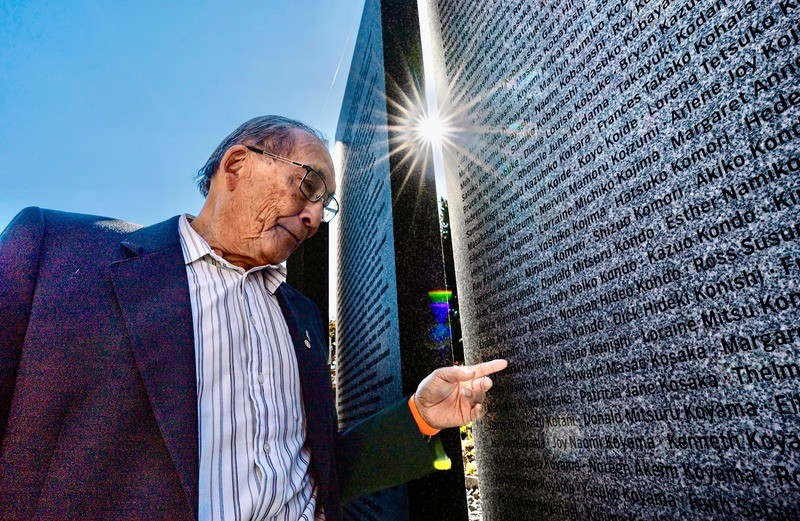
Victoria: A monument bearing the names of nearly 25,000 Japanese Canadians who were forcibly removed from their homes in British Columbia and interned during the Second World War was unveiled in Victoria on Saturday, with hundreds of survivors and descendants in attendance.
The monument, near the B.C. Legislature, sets the names in granite for the first time in one public record. They include about 22,000 people of Japanese descent who were uprooted beginning in 1942, along with roughly 3,000 children born after the displacement.
The names are carved across 100 granite panels and organized by the communities people called home before they were forced out, allowing families to reconnect names with places, according to the Japanese Canadian Legacies Society.
Survivors, descendants and families travelled from across B.C. and the rest of Canada for the opening, while many others watched by livestream from community gatherings, seniors' residences and homes.
“For generations, Japanese Canadians carried the memory of communities that were uprooted and scattered across British Columbia,” said Susanne Tabata, the society's CEO. “This monument makes those people, places and stories visible again, permanently.”
Tabata said the project reflects years of work by the community, in partnership with the province, to honour elders, restore heritage and ensure the history is carried forward.
A history of dispossession
Japanese Canadians had built families, businesses and communities in cities, towns, fishing villages and farming areas across B.C. for decades before 1942. After Canada's entry into the Pacific War that year, thousands were stripped of homes, property and businesses and sent to internment camps, the society said.
Thousands were exiled to Japan, though most were born in B.C. and had never been there. They were not allowed to return to the West Coast until 1949, four years after the war ended. No Japanese Canadian was ever found guilty of disloyalty to Canada, the society said.
Survivor Mary Kitagawa recalled the day her family's life on a 17-acre farm on Salt Spring Island ended. When she was seven, she said, an RCMP officer took her father away.
“My sisters and I ran after the truck, crying for him to come back, until it disappeared from sight. We did not know if we would ever see him again,” she said.
Survivor Howard Shimokura said seeing the family names together was moving and that much of the community's history was lost or remains unknown. “I hope people come to see all these names together, learn about the communities where we lived and carry that history forward,” he said.
Design and next steps
The monument is part of the province's work to recognize and make amends for injustices against Japanese Canadians. It was designed by KPMB Architects and PFS Studio and built by Chandos Construction, firms the society said were chosen through a competitive process based on cost, design quality and fit with the community's vision.
Opening-week events run from Oct. 3 to 7. The site will then close temporarily from Oct. 8 through the end of October for final construction work and is expected to reopen to visitors in November.
Support Our Journalism
We cannot do without you.. your contribution supports unbiased journalism
IBNS is not driven by any ism- not wokeism, not racism, not skewed secularism, not hyper right-wing or left liberal ideals, nor by any hardline religious beliefs or hyper nationalism. We want to serve you good old objective news, as they are. We do not judge or preach. We let people decide for themselves. We only try to present factual and well-sourced news.
Support objective journalism for a small contribution.


