Kenya stages largest-ever ivory destruction as UN reaffirms ‘zero tolerance’ on poaching
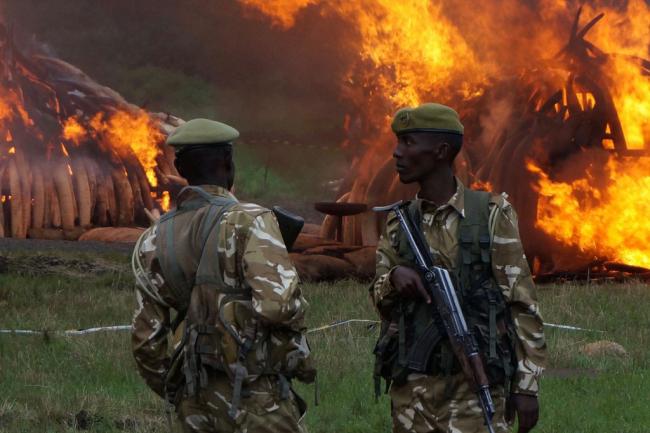
The burning of the 11 massive piles of ivory, which took place Saturday at Nairobi National Park, was organized by Kenya Wildlife Service and partners, and attended by the presidents of Kenya, Gabon and Uganda, as well as high-level UN officials, including Ibrahim Thiaw, Deputy Executive Director of the UN Environment Programme (UNEP), and Helen Clark, Administrator of the UN Development Programme (UNDP).
This multi-billion dollar worldwide trade is a security issue, an environmental issue, and a development issue.
In the ceremony, 105 tonnes of ivory and 1.3 tonnes of rhino horns, nearly all of Kenya’s elephant ivory and rhino horn stockpiles, were burned.
“We simply cannot afford to allow poaching to go on for one more day,” Thiaw said. “It does not make moral, economic or political sense.”
It is estimated that between 2010 and 2012, 100,000 elephants were killed for their ivory, out of a population of less than 500,000. The population of Forest Elephants has plummeted by two-thirds between 2002 and 2011 due to poaching, while reports released in 2015 show that African Savannah Elephants have declined by 60 per cent in Tanzania and by 50 per cent in Mozambique since 2009.
Finding ways to curb the illegal trade in wildlife, including elephant ivory, will be one of the top priorities for the second UN Environment Assembly (UNAE) the world's de facto parliament of environment, which will convene in Nairobi from 23 to 27 May to set the stage for early action on implementing the 2030 Agenda for Sustainable Development.
“We must also remember that wildlife has more value alive than dead and that wildlife can generate sustainable revenues to fund the education, healthcare and infrastructure that will lift people out of poverty and drive economic growth,” Thiaw said, stressing that by reconciling social, economic and environmental interests, Africa can harness its natural heritage to help deliver the 2030 Agenda.
In a separate high-level conservation event, ‘Space for Giants,’ Clark said on Sunday: “This multi-billion dollar worldwide trade is a security issue, an environmental issue, and a development issue.”
“It is pushing vulnerable and endangered species toward extinction. The illicit trade is also fuelling corruption and conflict, destroying lives, and deepening poverty and inequality,” she added.
Speaking at the ivory burning event, Kenyan President Uhuru Kenyatta stated that by killing elephants the continent risked losing its heritage in addition to destroying the highly beneficial tourism industry which has faced numerous threats in the recent past.
“No one has any business trading in ivory, for this trade means death of our elephants and death of our national heritage. In destroying the ivory, we reject once and for all, those who think our natural heritage can be sold for money” he said. “Ivory is worthless unless it is on a living elephant” he added.
He urged all stakeholders to become custodians of the planet and its wildlife. The Giants Club meeting was hosted by President Kenyatta, who was joined by President Ali Bongo Ondimba of Gabon, and President Yoweri Museveni of Uganda.
“To all poachers, buyers and traders – your days are numbered. We will put you out of business so go on retirement now,” said President Bongo just before participating in the burning of the ivory and horns.
Photo: Convention on International Trade in Endangered Species of Wild Fauna and Flora (CITES).
Support Our Journalism
We cannot do without you.. your contribution supports unbiased journalism
IBNS is not driven by any ism- not wokeism, not racism, not skewed secularism, not hyper right-wing or left liberal ideals, nor by any hardline religious beliefs or hyper nationalism. We want to serve you good old objective news, as they are. We do not judge or preach. We let people decide for themselves. We only try to present factual and well-sourced news.
Support objective journalism for a small contribution.