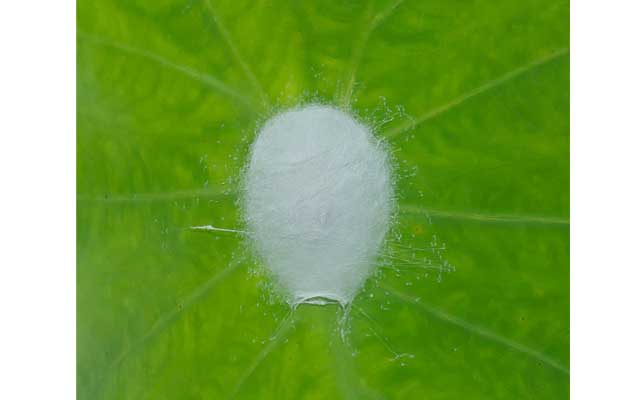
Green method developed for making artificial spider silk
A team of architects and chemists from the University of Cambridge has designed super-stretchy and strong fibres which are almost entirely composed of water, and could be used to make textiles, sensors and other materials.
The fibres, which resemble miniature bungee cords as they can absorb large amounts of energy, are sustainable, non-toxic and can be made at room temperature, read the University of Cambridge website.
This new method not only improves upon earlier methods of making synthetic spider silk, since it does not require high energy procedures or extensive use of harmful solvents, but it could substantially improve methods of making synthetic fibres of all kinds, since other types of synthetic fibres also rely on high-energy, toxic methods. The results are reported in the journal Proceedings of the National Academy of Sciences.
Spider silk is one of nature’s strongest materials, and scientists have been attempting to mimic its properties for a range of applications, with varying degrees of success. “We have yet to fully recreate the elegance with which spiders spin silk,” said co-author Dr Darshil Shah from Cambridge’s Department of Architecture.
The fibres designed by the Cambridge team are “spun” from a soupy material called a hydrogel, which is 98% water. The remaining 2% of the hydrogel is made of silica and cellulose, both naturally available materials, held together in a network by barrel-shaped molecular “handcuffs” known as cucurbiturils. The chemical interactions between the different components enable long fibres to be pulled from the gel.
The fibres are pulled from the hydrogel, forming long, extremely thin threads – a few millionths of a metre in diameter. After roughly 30 seconds, the water evaporates, leaving a fibre which is both strong and stretchy.
“Although our fibres are not as strong as the strongest spider silks, they can support stresses in the range of 100 to 150 megapascals, which is similar to other synthetic and natural silks,” said Shah. “However, our fibres are non-toxic and far less energy-intensive to make.”
The fibres are capable of self-assembly at room temperature, and are held together by supramolecular host-guest chemistry, which relies on forces other than covalent bonds, where atoms share electrons.
“When you look at these fibres, you can see a range of different forces holding them together at different scales,” said Yuchao Wu, a PhD student in Cambridge’s Department of Chemistry, and the paper’s lead author. “It’s like a hierarchy that results in a complex combination of properties.”
The strength of the fibres exceeds that of other synthetic fibres, such as cellulose-based viscose and artificial silks, as well as natural fibres such as human or animal hair.
In addition to its strength, the fibres also show very high damping capacity, meaning that they can absorb large amounts of energy, similar to a bungee cord. There are very few synthetic fibres which have this capacity, but high damping is one of the special characteristics of spider silk. The researchers found that the damping capacity in some cases even exceeded that of natural silks.
“We think that this method of making fibres could be a sustainable alternative to current manufacturing methods,” said Shah. The researchers plan to explore the chemistry of the fibres further, including making yarns and braided fibres.
This research is the result of a collaboration between the Melville Laboratory for Polymer Synthesis in the Department of Chemistry, led by Professor Oren Scherman; and the Centre for Natural Material Innovation in the Department of Architecture, led by Dr Michael Ramage. The two groups have a mutual interest in natural and nature-inspired materials, processes and their applications across different scales and disciplines.
The research is supported by the UK Engineering and Physical Sciences Research Council (EPSRC) and the Leverhulme Trust.
Text: University of Cambridge website
Image:wikimedia commons
Support Our Journalism
We cannot do without you.. your contribution supports unbiased journalism
IBNS is not driven by any ism- not wokeism, not racism, not skewed secularism, not hyper right-wing or left liberal ideals, nor by any hardline religious beliefs or hyper nationalism. We want to serve you good old objective news, as they are. We do not judge or preach. We let people decide for themselves. We only try to present factual and well-sourced news.
Support objective journalism for a small contribution.