


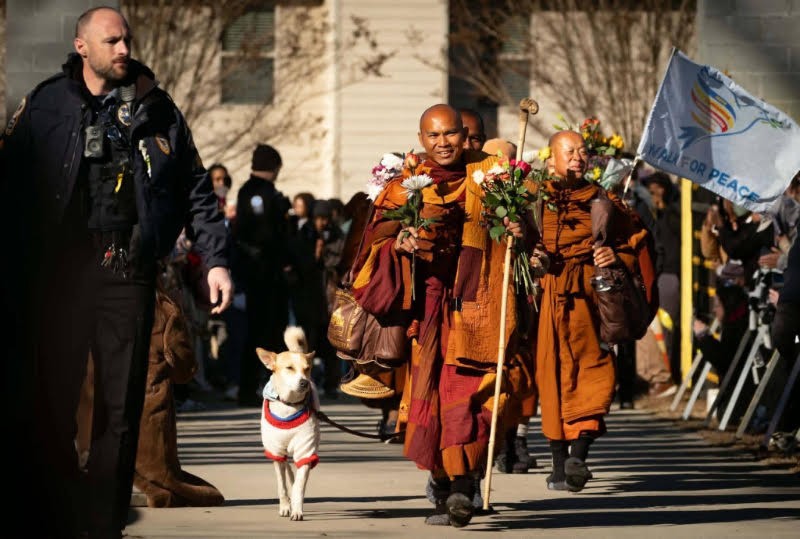
 Aloka
Aloka
From Indian streets to America’s highways: How Aloka 'The Peace Dog’ walked into hearts worldwide
Aloka’s journey began not with intention, but with instinct.
During a 100-day peace walk across India, a group of Buddhist monks encountered a stray dog who quietly began following them.
Without training, command, or coaxing, the dog appeared to choose the monks as his family.
They named him Aloka, a word associated with light and clarity, and continued their march for harmony with their unexpected companion walking faithfully beside them.
Believed to be an Indian Pariah dog, Aloka stayed with the monks through long days on the road, heat, fatigue, and uncertainty, gradually becoming an inseparable part of the walk.
Loyalty tested on Indian roads
Aloka’s devotion was tested early in the journey.
During the Indian leg of the peace march, he was struck by a car and later fell seriously ill.
Alarmed for his safety, the monks placed him in a truck to spare him from the physical strain of walking.
But Aloka had other ideas. He leapt out of the vehicle and returned to the road, determined to walk with the group.
Videos shared by the monks captured the moment, with one monk calling him a “true hero” who simply wanted to keep going.
The clip resonated widely online, marking the beginning of Aloka’s transformation from a stray dog to a symbol of resilience.
From India to the US
What started as a journey across India eventually crossed continents.
The monks, now based at the Huong Dao Vipassana Bhavana in Fort Worth, Texas, began a new Walk for Peace in October, covering 2,300 miles from Fort Worth to Washington, DC.
Aloka, once again, walked alongside them.
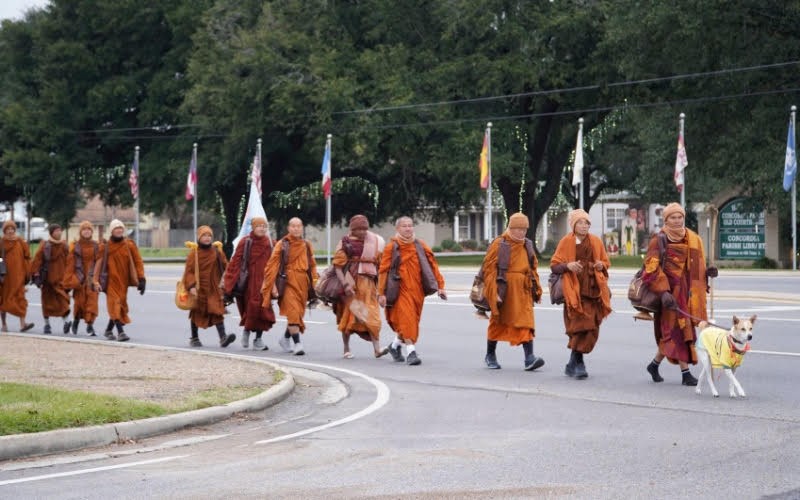
The group of 19 monks and their canine companion set out on a route spanning 10 US states over roughly 110 days, aiming to spread messages of compassion, unity, and interfaith harmony.
By late December, they had already reached Atlanta, drawing attention from communities along the way.
Life on the road and growing fame
As the journey continued, Aloka’s presence began drawing crowds.
Passersby stopped to pet him, offer treats, and take photos as he trotted confidently at the front or rested patiently beside the monks during prayer stops.
Videos showed him sunbathing, posing for the camera, and wagging his tail at admirers.
Social media amplified his story.
The Instagram account @alokathepeacedog, launched in December, amassed more than 1.4 lakh followers within weeks, while his Facebook page crossed 3.5 lakh followers.
One video of Aloka leading the monks in a white-collared black sweater garnered over two million views, cementing his status as a viral sensation.
The ‘Dog of Peace’
Aloka’s calm temperament has become central to his appeal. In one widely shared video, he encounters a wild boar but responds not with aggression, instead approaching playfully.
Viewers hailed the moment as proof of his peaceful spirit, with one user commenting that if Aloka could coexist with a wild animal, harmony among humans was surely possible.
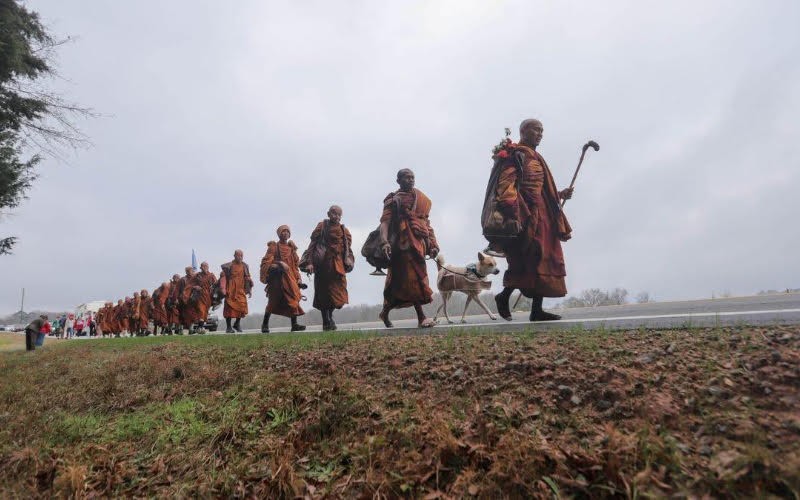
Monks describe him as gentle, patient, and deeply connected to the group.
He waits quietly during prayers, visits temples, and observes the rituals without disruption, embodying the calm the walk seeks to promote.
Walking through cold, choice and care
As winter deepens in the US, the monks sometimes place Aloka in an RV to protect his health.
Yet his preference is clear. When given the chance, he chooses to walk.
Even inside the vehicle, he claims the window seat, watching the monks continue their journey on foot.
Texas Representative Nicole Collier, reflecting on the walk, said the journey stood out in a time when division often overwhelms dialogue.
For many, Aloka’s steady presence has become a quiet reminder of unity and shared purpose.
A symbol larger than the journey
Expected to conclude in Washington, DC, in February, the walk continues to draw attention not only for its message, but for the dog who never meant to become its face.
Once abandoned on Indian streets, Aloka now walks thousands of miles as a global symbol of peace, resilience, and unwavering loyalty.
Support Our Journalism
We cannot do without you.. your contribution supports unbiased journalism
IBNS is not driven by any ism- not wokeism, not racism, not skewed secularism, not hyper right-wing or left liberal ideals, nor by any hardline religious beliefs or hyper nationalism. We want to serve you good old objective news, as they are. We do not judge or preach. We let people decide for themselves. We only try to present factual and well-sourced news.
Support objective journalism for a small contribution.


