Four judges elected to serve on International Court of Justice
After simultaneous rounds of voting in the Assembly and the Council – which met concurrently with but independent of each other – Mohamed Bennouna of Morocco, James Richard Crawford of Australia, Joan E. Donoghue of the United States, and Kirill Gevorgian of the Russian Federation were elected to nine-year terms on the ICJ, starting on 6 February next year.
The Assembly and the Council will meet independently again on Friday to elect a fifth judge to a seat on the ICJ.
The Court is composed of 15 judges, who are elected by an absolute majority in both the General Assembly (97 votes) and Security Council (8 votes). The timing of elections is staggered so that the General Assembly elects a third of the Court once every three years.
The terms of five judges will expire on 5 February 2015: Bernardo Sepúlveda-Amor (Mexico); Kenneth Keith (New Zealand); Mohamed Bennouna (Morocco); Leonid Skotnikov (Russian Federation); and Joan E. Donoghue (United States). Judges are eligible for re-election.
According to the Court's Statute, its judges must be chosen by coordinated actions of both the Council and the General Assembly, with the date of elections determined by the Council.
Judges are chosen on the basis of their qualifications, not their nationality, but no two judges can be from the same country. Effort is also taken to ensure that the principal legal systems of the world are reflected in the composition of the court.
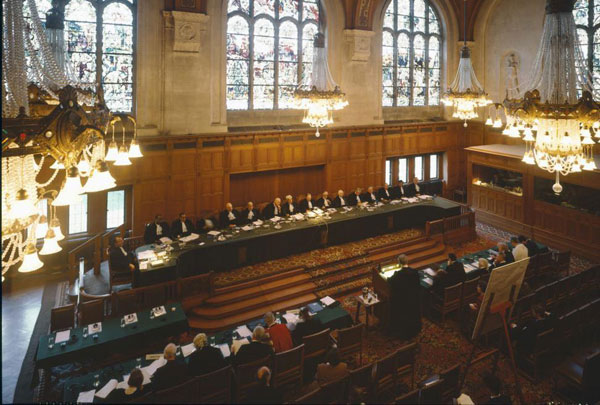
Established in 1945, and based in The Hague in the Netherlands, the ICJ – which is also known as the World Court – settles legal disputes between States and gives advisory opinions on legal questions that have been referred to it by other authorized UN organs.
General view of the International Court of Justice (ICJ) in session. UN Photo/Andrea Brizzi
Support Our Journalism
We cannot do without you.. your contribution supports unbiased journalism
IBNS is not driven by any ism- not wokeism, not racism, not skewed secularism, not hyper right-wing or left liberal ideals, nor by any hardline religious beliefs or hyper nationalism. We want to serve you good old objective news, as they are. We do not judge or preach. We let people decide for themselves. We only try to present factual and well-sourced news.
Support objective journalism for a small contribution.