 South Korea
Former South Korean President Yoon Suk Yeol sentenced to life over failed martial law bid
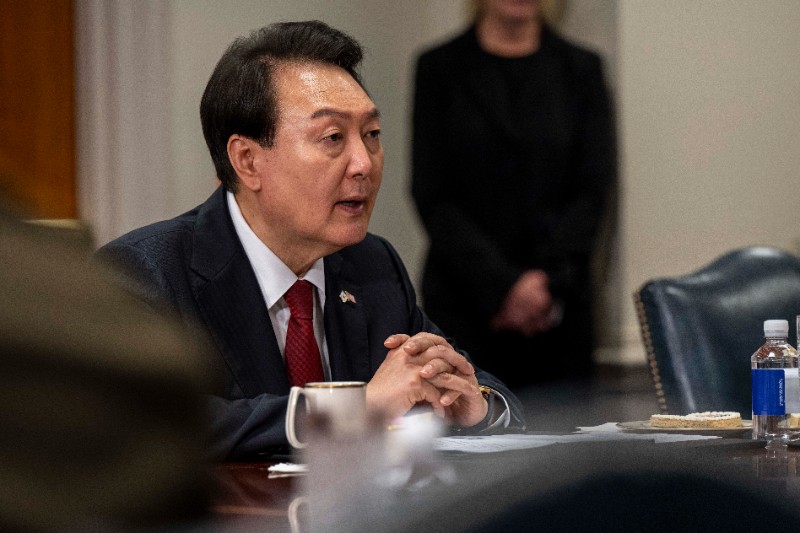
Seoul/IBNS: Former South Korean President Yoon Suk Yeol has been sentenced to life imprisonment for his brief but dramatic imposition of martial law in December 2024, a move the court ruled amounted to rebellion against the state.
Delivering the verdict, Judge Jee Kui-youn said Yoon unlawfully mobilised military and police forces in an attempt to seize control of the liberal-led National Assembly, detain political opponents and establish unchecked authority for a “considerable” period.
Judges cite 'illegal use' of force
The court found that Yoon’s actions had no constitutional basis and directly undermined democratic governance in South Korea.
Prosecutors argued that the former president’s use of armed forces to block lawmakers constituted a direct assault on the constitutional order.
While a special prosecutor had sought the death penalty, citing the gravity of the threat posed to democracy, the court stopped short of capital punishment.
Legal analysts noted that the poorly executed power grab resulted in no fatalities, making a life sentence the more likely outcome.
South Korea has not carried out an execution since 1997, a long-standing practice widely regarded as an unofficial moratorium on the death penalty.
Courtroom tensions and street protests
Heavy security surrounded the judicial complex as Yoon was brought to court, with hundreds of police deployed to monitor rival demonstrations.
His supporters gathered outside, chanting slogans in his defence, while critics assembled nearby, calling for the harshest possible punishment as the prison vehicle transporting him passed.
Senior officials also convicted
The court also handed down lengthy prison terms to several former military and police officials involved in enforcing the martial law decree.
Former defence minister Kim Yong Hyun received a 30-year sentence for his central role in planning the operation and mobilising troops.
Judges said the involvement of senior security officials demonstrated the seriousness of the attempted takeover and the extent of institutional misuse.
Yoon defends decree as political necessity
A staunch conservative, Yoon has consistently defended his decision, claiming the extraordinary measure was needed to counter what he described as “anti-state” liberal forces obstructing his agenda through their parliamentary majority.
The decree, however, lasted just six hours. Lawmakers eventually breached a military blockade, assembled a quorum and unanimously voted to revoke martial law, restoring civilian rule.
Impeachment and removal from office
Yoon was suspended from office on December 14, 2024, after lawmakers voted to impeach him.
He was formally removed in April 2025 after the Constitutional Court upheld the impeachment.
He has remained in custody since July while facing multiple criminal proceedings, with the rebellion charge carrying the most severe penalty.
Previous convictions add to sentence
Last month, Yoon was separately sentenced to five years in prison for resisting arrest, fabricating the martial law proclamation and bypassing a legally required full Cabinet meeting before issuing the decree.
The Seoul Central Court has also convicted other senior figures from Yoon’s administration.
Among them was former prime minister Han Duck-soo, who received a 23-year sentence for attempting to legitimise the decree through a forced Cabinet Council meeting, falsifying official records and lying under oath.
Han has since appealed the ruling, while Yoon is widely expected to challenge the life sentence.
Support Our Journalism
We cannot do without you.. your contribution supports unbiased journalism
IBNS is not driven by any ism- not wokeism, not racism, not skewed secularism, not hyper right-wing or left liberal ideals, nor by any hardline religious beliefs or hyper nationalism. We want to serve you good old objective news, as they are. We do not judge or preach. We let people decide for themselves. We only try to present factual and well-sourced news.
Support objective journalism for a small contribution.