


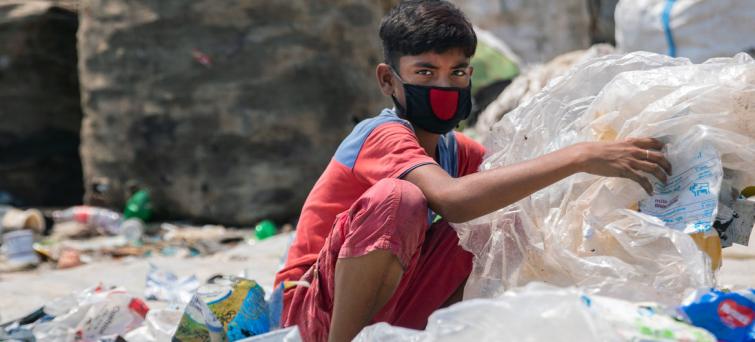
COVID-19 upends ‘entire generation’ of 600 million South Asian children
New York/IBNS: Without urgent action, COVID-19 will continue to unravel decades of progress across South Asia, destroying the “hopes and futures of an entire generation”, warns a new report released on Tuesday by the UN Children’s Fund, UNICEF.
Find out the actions #UNICEF is calling on governments in South Asia to take to avoid devastating long-term impacts.
How COVID-19 threatens the futures of 600 million South Asian children
“The side-effects of the pandemic across South Asia, including the lockdown and other measures, have been damaging for children in numerous ways”, said Jean Gough, UNICEF Regional Director for the vast region. “But the longer-term impact of the economic crisis on children will be on a different scale entirely”.
Catastrophic consequences
The report illustrates the disastrous toll of the virus on some 600 million South Asian children, such as growing food insecurity and the disruption of immunization, nutrition and other vital health services, that could be potentially life-threatening for around 459,000 over the next six months.
Meanwhile, school closures have pushed more than 430 million children into remote learning, which has only partially filled the gap as many households in rural areas lack both internet access and electricity.
At the same time, concerns are heightening that some disadvantaged students may join the nearly 32 million children who were already out of school, before COVID-19 struck.
This all comes against a backdrop of children struggling with depression and a surge in calls to help hotlines, as they suffer violence and abuse during home confinement.
The report notes that life-saving vaccination campaigns against measles, polio and other diseases must resume, along with work to help an estimated 7.7 million children – more than half the global total – who are suffering from severe wasting, which impairs physical and mental development.
Moreover, as soon as possible, schools should reopen with adequate handwashing and other physical distancing precautions in place.
Economic turmoil
The economic shock triggered by COVID-19 is hitting families hard across the region, with large-scale job losses, wage cuts and remittance losses from overseas workers and through tourism.
According to UNICEF projections, as many as 120 million more children could be pushed into poverty and food insecurity over the next six months, joining some 240 million children already classified as poor.
To mitigate the impact, the report maintains that Governments should immediately direct more resources towards social protection schemes, including emergency universal child benefits and school feeding programmes.
“Putting such measures in place now will help the countries of South Asia transition faster from the humanitarian crisis caused by COVID-19 to a resilient and sustainable development model, with long term benefits for child wellbeing, the economy, and social cohesion”, said Gough.
Support Our Journalism
We cannot do without you.. your contribution supports unbiased journalism
IBNS is not driven by any ism- not wokeism, not racism, not skewed secularism, not hyper right-wing or left liberal ideals, nor by any hardline religious beliefs or hyper nationalism. We want to serve you good old objective news, as they are. We do not judge or preach. We let people decide for themselves. We only try to present factual and well-sourced news.
Support objective journalism for a small contribution.


