#Climatechain: UN to launch campaign illustrating water-environment-climate change link
On the eve of the world Day, the UN Children's Fund (UNICEF) is warning about the safety concerns due to climate change, as water becomes scarce during droughts, flooding damages water and sewage treatment facilities, and water-borne diseases, such as cholera and diarrhoea, spread more quickly.
“Now that we can test water more cheaply and efficiently than we were able to do when the MDGs were set, we are coming to terms with the magnitude of the challenge facing the world when it comes to clean water,” said Sanjay Wijeserkera, head of UNICEF's global water, sanitation and hygiene programmes.
She was referring to the MDGs or the Millennium Development Goals which led international anti-poverty efforts between the years 2000 and 2015. Last September, the international community jointly approved the new Sustainable Development Goals (SDGs) which call for “safe water for everyone.”
“It's a whole new ball game,” said Wijeserkera, noting that the new SDGs do not simply start off where the MDGs left off.
In 2015, all but 663 million people had access to drinking water from improved sources. But newly available testing technology show that an estimated 1.8 billion people may be drinking water contaminated by e-coli, meaning there is faecal material in their water, even from some improved sources.
In addition, there are now concerns about diseases such as Zika, which are spread by mosquitos whose populations are growing and expanding geographically due to changing weather patterns.
Given these and other concerns, UNICEF is launching a global Instagram campaign that will run from World Water Day, marked tomorrow, until 22 April, when the Paris Agreement, which was adopted by world leaders in France last December, will be open for signature.
UNICEF Executive Director Anthony Lake, UN General Assembly President Mogens Lykketoft, and UN climate chief Christiana Figueres are among the first supporters expected to illustrate these challenges using the #ClimateChain hashtag.
Meanwhile at the event at UN Headquarters, which also marked the International Day of Forests, senior UN officials highlighted the importance of improving water quality and water supplies.
“The need for the sustainable management of forest and water resources is explicitly recognised in SDG 6 and SDG 15; however these vital resources are important for all SDGs,” said Wu Hongbo, the Under-Secretary-General for Economic and Social Affairs.
He underlined that water resources maintain jobs across all sectors of the global economy –including agriculture, forestry and industry – and decent jobs and training are likewise needed in order maintain and extend water and forestry services.
“This is just one example of the complex inter-linkages among forest and water issues,” Wu noted. “Clearly, if we are to successfully implement the Sustainable Development Goals and targets on forests and water, we can only do so through an integrated and coordinated approach.”
Through the course of the event, participants heard different perspectives on how forests and water hold the key to the future – from building resilient urban communities and protecting coastal regions from storm surges, and how various stakeholders are taking action to manage and conserve these vital natural resources.
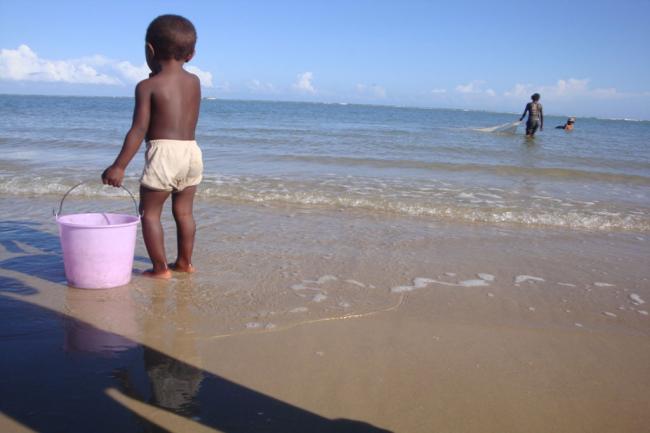
Photo: UNICEF/UNI72915/de Paul
Support Our Journalism
We cannot do without you.. your contribution supports unbiased journalism
IBNS is not driven by any ism- not wokeism, not racism, not skewed secularism, not hyper right-wing or left liberal ideals, nor by any hardline religious beliefs or hyper nationalism. We want to serve you good old objective news, as they are. We do not judge or preach. We let people decide for themselves. We only try to present factual and well-sourced news.
Support objective journalism for a small contribution.