


 China
China
China deploys J-20 stealth fighters near India border, satellite images reveal major airpower build-up
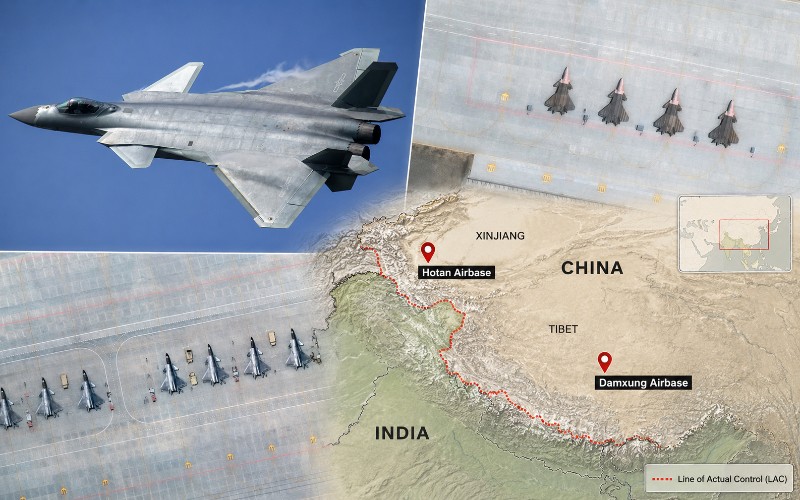
China has deployed at least 12 J-20 stealth fighter jets at two airbases facing India, according to commercial satellite imagery, highlighting the growing presence of Beijing’s advanced combat aircraft close to the Line of Actual Control (LAC).
The satellite images, captured by commercial satellite company Vantor and shared with India Today, show J-20 aircraft stationed at Hotan airbase in Xinjiang and Damxung airbase in Tibet.
The deployment represents one of the largest concentrations of China’s fifth-generation stealth fighters observed at airbases opposite India in recent years.
Eight J-20s spotted at Hotan airbase
Eight J-20 “Mighty Dragon” fighters were visible on the tarmac at Hotan airbase in imagery dated July 9.
Hotan is a dual-use civil-military facility in China’s Xinjiang Uyghur Autonomous Region.
The airbase is approximately 245 km from the Indian Air Force’s forward airbase at Daulat Beg Oldie in northern Ladakh and around 389 km from Leh.
The location gives the J-20s a strategically significant position close to the northern sector of the India-China border.
The aircraft’s presence at Hotan is particularly notable because of the airbase’s proximity to the high-altitude areas where India and China maintain substantial military deployments.
Four more stealth fighters at Damxung
A separate satellite image dated June 25 showed four additional J-20 fighters at Damxung airbase in Tibet’s Lhasa prefecture.
The aircraft were seen parked beneath protective canopy structures, making the deployment less immediately visible from the ground.
Damxung lies approximately 344 km northwest of Tawang in Arunachal Pradesh, another strategically sensitive area along the India-China frontier.
With eight aircraft at Hotan and four at Damxung, the satellite imagery accounts for at least 12 J-20s observed at the two locations over a period of roughly two weeks.
The concentration is among the largest publicly observed deployments of the aircraft at Chinese bases facing India in recent years.
Why J-20 deployment matters
The Chengdu J-20 is China's premier operational stealth fighter and forms a key part of the People's Liberation Army Air Force’s (PLAAF) modernisation programme.
The aircraft uses a low-observable design intended to reduce its radar signature, allowing it to operate with a lower probability of detection by enemy radar systems.
Its deployment at high-altitude bases in Tibet and Xinjiang has particular significance because operating advanced combat aircraft in such environments presents additional challenges involving altitude, temperature, payload and range.
Defence sources cited in the report said repeated sightings of J-20s at airbases opposite India suggest that forward deployment of the aircraft may increasingly become a regular component of China's military posture along the LAC rather than being limited to temporary movements.
China expands military infra along LAC
Hotan and Damxung have previously featured in assessments of Chinese military activity near the LAC.
Earlier satellite imagery has shown J-20 fighters rotating through these facilities, although the numbers observed at the bases were generally smaller.
The latest imagery points to a larger forward presence and comes amid China's wider effort to modernise the PLAAF and expand military infrastructure across Xinjiang and Tibet.
China has been upgrading airfields, roads, logistics facilities and other military infrastructure in the region, strengthening its ability to sustain air operations in areas close to the disputed border.
The deployment of advanced aircraft at these locations also reflects the importance Beijing places on maintaining a credible airpower presence across the western and eastern sectors of the frontier.
India faces fighter squadron pressure
The development comes as the Indian Air Force continues to deal with pressure on its fighter aircraft strength.
India's indigenous Light Combat Aircraft Tejas Mk1A programme has faced delays, while the proposed acquisition of 114 multi-role fighter aircraft remains under the country's lengthy defence procurement process.
The Indian Air Force has also been pursuing efforts to modernise its fighter fleet as older platforms gradually approach retirement.
The imbalance between the number of operational fighter squadrons and the authorised strength has remained a longstanding concern for Indian defence planners.
The presence of J-20s near the LAC therefore adds another dimension to India's requirement for modern combat aircraft and stronger airpower infrastructure along the frontier.
India-China border remains heavily militarised
India and China share a disputed 3,488-km frontier, with the LAC separating territories controlled by the two countries.
Relations deteriorated sharply after the deadly Galwan Valley clash in eastern Ladakh in June 2020.
Both sides subsequently deployed large numbers of troops, armour, artillery and air assets along the frontier.
Multiple rounds of military and diplomatic talks have since resulted in disengagement at several friction points.
However, the broader border continues to remain heavily militarised, with both countries maintaining substantial military infrastructure and forces in strategically important areas.
Advanced fighter aircraft have become an increasingly important component of this posture.
J-20 presence adds to airpower competition
The latest satellite imagery places the J-20 at the centre of the continuing military competition along the India-China frontier.
The deployment of at least 12 aircraft at Hotan and Damxung demonstrates China's ability to position its most advanced fighter aircraft at bases close to sensitive sectors of the LAC.
For India, the development comes amid efforts to strengthen its fighter strength, accelerate indigenous aircraft production and expand the country's ability to respond to China's growing military infrastructure along the frontier.
The latest imagery provides another snapshot of the evolving airpower balance along one of Asia's most closely watched and heavily militarised borders.
Support Our Journalism
We cannot do without you.. your contribution supports unbiased journalism
IBNS is not driven by any ism- not wokeism, not racism, not skewed secularism, not hyper right-wing or left liberal ideals, nor by any hardline religious beliefs or hyper nationalism. We want to serve you good old objective news, as they are. We do not judge or preach. We let people decide for themselves. We only try to present factual and well-sourced news.
Support objective journalism for a small contribution.


