Canada unveils nearly $70B clean energy investment in Newfoundland and Labrador, Québec
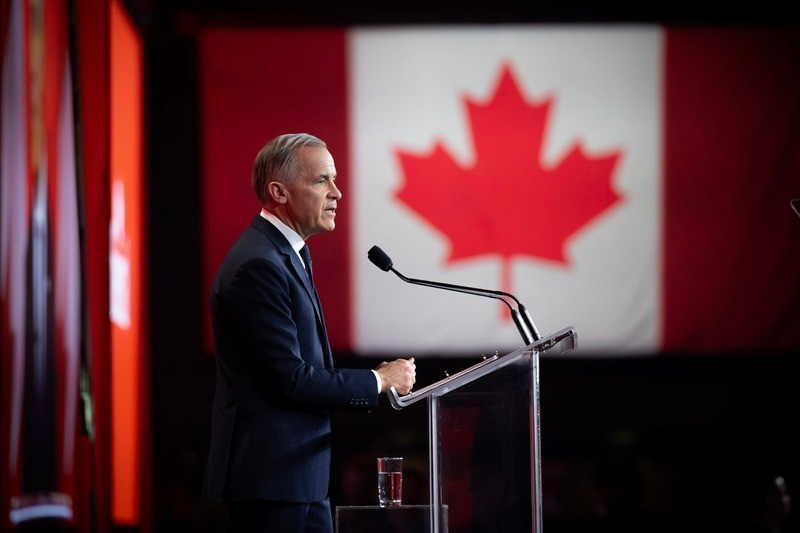
Ottawa: Prime Minister Mark Carney announced a nearly $70 billion clean energy investment involving the expansion of the Churchill Falls Generating Station, development of the Gull Island hydroelectric project and new transmission infrastructure across Newfoundland and Labrador and Québec.
The federal government will provide $10 billion in financing for the projects, which are expected to generate a combined 14,000 megawatts of clean, renewable electricity, nearly tripling Churchill Falls’ current generating capacity.
The agreement was announced by Carney alongside Québec Premier Christine Fréchette, Newfoundland and Labrador Premier Tony Wakeham, and the CEOs of Hydro-Québec and Newfoundland and Labrador Hydro.
According to the federal government, the projects will support 23,000 jobs and contribute approximately $31 billion to Canada’s GDP through the early 2040s.
The federal financing will support the modernisation and expansion of Churchill Falls, the development of Gull Island, associated transmission lines and co-investment opportunities with the Innu of Labrador in a major new onshore wind project.
“Canada is extending its unique advantage in clean, reliable, and affordable power,” Carney said. “Through cooperative federalism, we are unlocking our immense potential, building big, building sustainably, building in partnership, and building Canada strong for all.”
Focus shifts to critical minerals
The agreement also includes efforts to develop the Labrador Trough, a major mining region spanning Newfoundland and Labrador and Québec that contains significant deposits of high-purity iron ore.
The federal government has referred the Labrador Trough Clean Power, Critical Minerals and Infrastructure Corridor to the Major Projects Office.
The office will coordinate federal financing, accelerate permitting and work with Indigenous communities to develop partnerships.
Ottawa will also support several pre-development projects through the First and Last Mile Fund, including transmission expansion in Labrador West, infrastructure planning for the Kami iron ore project, a proposed transmission line and road for the Lac Knife graphite project, and expanded critical minerals handling and rail infrastructure at SFP Pointe-Noire.
The government said these projects are intended to connect critical minerals operations to reliable electricity and transportation infrastructure while supporting mine electrification and the development of battery and energy-storage supply chains.
Energy security and economic strategy
The announcement comes as the federal government seeks to strengthen Canada’s domestic energy infrastructure and reduce vulnerabilities in an increasingly uncertain global economy.
The government said the projects advance its National Electricity Strategy, which aims to double Canada’s electricity grid capacity by 2050, as well as the Atlantic Energy Strategy, which focuses on expanding renewable and non-emitting energy across Atlantic Canada.
Canada currently generates about 80% of its electricity from non-emitting sources, according to the federal government.
The government said it is also using clean-economy investment tax credits, financing from the Canada Infrastructure Bank and Canada Growth Fund, and the Indigenous Loan Guarantee Program to encourage large-scale investment in clean energy and critical infrastructure.
The federal government described the agreement as the largest clean energy investment in North American history, positioning the Churchill Falls and Gull Island projects at the centre of its strategy to expand Canada’s electricity capacity, develop critical minerals and strengthen the country’s economic and energy security.
Support Our Journalism
We cannot do without you.. your contribution supports unbiased journalism
IBNS is not driven by any ism- not wokeism, not racism, not skewed secularism, not hyper right-wing or left liberal ideals, nor by any hardline religious beliefs or hyper nationalism. We want to serve you good old objective news, as they are. We do not judge or preach. We let people decide for themselves. We only try to present factual and well-sourced news.
Support objective journalism for a small contribution.