


 Canada-Japan
Canada, Japan launch Comprehensive Strategic Partnership across defence, energy and technology
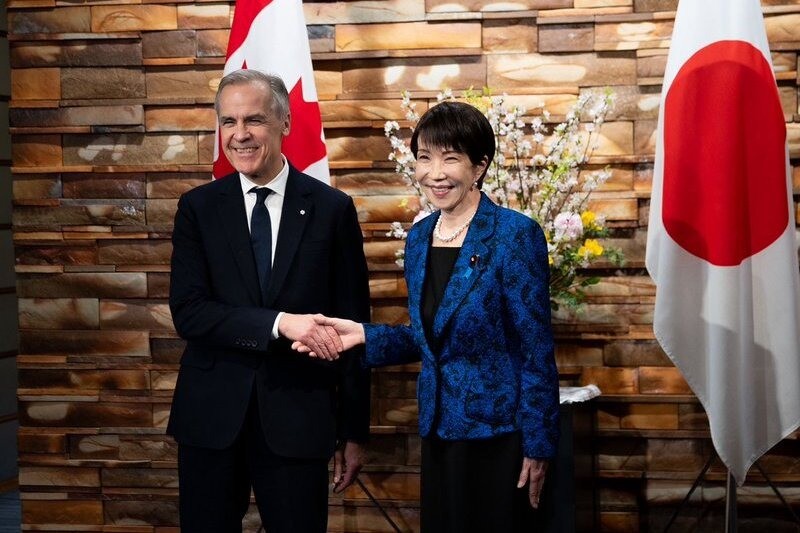
Tokyo: Canada and Japan have announced a sweeping Comprehensive Strategic Partnership aimed at strengthening cooperation in defence, energy, trade, and advanced technologies, following talks between Canadian Prime Minister Mark Carney and Japanese Prime Minister Sanae Takaichi in Tokyo on Friday.
The agreement seeks to deepen ties between the two Indo-Pacific partners and expand economic collaboration while reinforcing regional security cooperation.
According to a joint statement released after the meeting, the partnership will focus on defence cooperation, critical minerals, clean energy, and emerging technologies such as artificial intelligence.
Defence and security cooperation
The two countries agreed to expand defence cooperation through several new initiatives, including three bilateral memorandums of cooperation covering emergency response, Coast Guard exercises, and joint efforts to combat illegal fishing in the North Pacific.
The leaders also pledged to increase joint military exercises and training activities involving the Canadian Armed Forces and Japan’s Self-Defense Forces.
Officials said the expanded cooperation could include joint naval operations and potential Japanese participation in Canada’s Arctic-focused Operation NANOOK.
Both countries also announced the creation of a Canada–Japan Cyber Policy Dialogue to strengthen cooperation on cybersecurity, including information sharing and responses to emerging cyber threats.
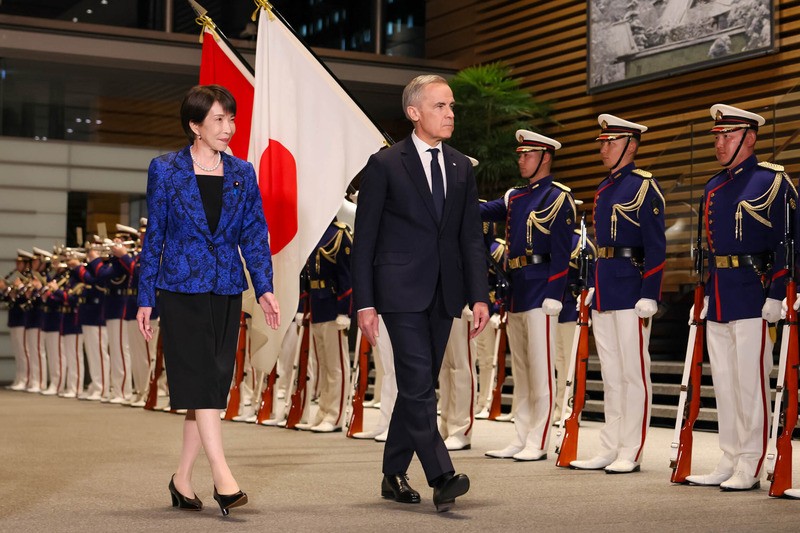 Photo: Sanae Takaichi/X
Expanding trade and investment
The partnership also seeks to deepen trade and investment ties. Officials said both governments will instruct their agencies to identify new investment opportunities, including through pension funds and corporate partnerships.
Canada and Japan will also modernize the Canada-Japan Joint Economic Committee, a bilateral forum that has guided economic cooperation for more than 50 years.
Future cooperation is expected to focus on sectors such as semiconductors, batteries, clean energy, artificial intelligence, and resilient supply chains.
Trade missions are also planned, including a Team Canada trade mission to Japan in 2026, as well as a visit to Canada by the Japan Business Federation aimed at expanding commercial partnerships.
Energy and technology collaboration
Energy security and the transition to low-carbon energy were key elements of the agreement. Both sides committed to expanding cooperation in liquefied natural gas, hydrogen technologies, nuclear energy, and carbon capture and storage.
The leaders also pledged deeper collaboration in advanced technologies such as artificial intelligence, quantum technologies, cybersecurity, and semiconductor manufacturing.
In addition, Canada and Japan agreed to strengthen cooperation on critical minerals, including joint efforts to secure supply chains essential for clean energy technologies and advanced manufacturing.
Broader Indo-Pacific strategy
The Tokyo meeting forms part of Prime Minister Carney’s broader diplomatic tour of the Indo-Pacific region, which has included visits to India and Australia.
During the India visit, Canada secured more than $5 billion in commercial agreements, while talks in Australia resulted in expanded cooperation in defence, artificial intelligence, and critical minerals, along with investment commitments worth up to $10 billion.
Speaking about the Japan partnership, Carney said the two countries share common interests in strengthening economic security and maintaining stability in the Indo-Pacific region.
“Japan is a trusted partner and a global leader in innovation and advanced manufacturing,” Carney said.
“By expanding and modernising our partnership, we are creating long-term opportunities for our workers and building a more secure and resilient future for both countries.”
Canada and Japan already maintain strong economic ties. Japan is Canada’s fourth-largest source of foreign direct investment, and bilateral trade between the two countries is valued at nearly $40 billion annually.
Japanese companies also play a major role in Canada’s manufacturing sector, producing roughly 70% of cars made in the country.
Support Our Journalism
We cannot do without you.. your contribution supports unbiased journalism
IBNS is not driven by any ism- not wokeism, not racism, not skewed secularism, not hyper right-wing or left liberal ideals, nor by any hardline religious beliefs or hyper nationalism. We want to serve you good old objective news, as they are. We do not judge or preach. We let people decide for themselves. We only try to present factual and well-sourced news.
Support objective journalism for a small contribution.


