


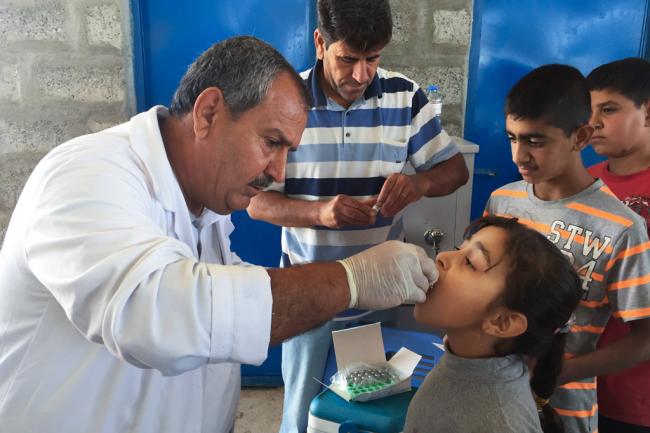
Amid fears of cholera outbreak in Iraq, UN agencies support government-led response
“There is unfortunately a high risk that cholera will reach more areas of Iraq, affecting marginalized and displaced children, women and their families in particular, so we have to act fast,” UNICEF Representative in Iraq Peter Hawkins said in a statement released on Friday.
UNICEF is part of urgent efforts underway to protect communities and families from the effects of a cholera outbreak that has already infected more than 2,200 people – about 20 per cent of them children – across 15 of the country’s 18 governorates.
With concern rising that the disease could spread further, UNICEF – alongside the World Health Organisation (WHO) – indicates that it has provided support to the Iraqi Ministry of Health, delivered and secured clean water supplies, offered treatment for people with cholera symptoms, and undertaken a national communication campaign to help people protect themselves against the disease.
“Heavy rains in late October inundated several areas of the country considered vulnerable to the spread of cholera,” addressing in the statement, UNICEF also mentioned that 65,000 residents near Baghdad had been affected by the overflow sewage system due to the extensive flooding.
According to the statement, “since the cholera outbreak was confirmed in mid-September, UNICEF has supported the distribution of bottled water to 37,000 people, and water trucking at a rate of 100,000 litres per day, benefitting 5,000 people. Community water tanks sufficient for 15,500 people have been installed, and family water and hygiene kits distributed to 44,250 families.”
In order to ensure household water supplies were properly disinfected, UNICEF explained that 1.3 million water treatment tablets for household usage and 1,000 water treatment tablets for use in community water storage tanks had already been distributed.
Hawkins said the important part of UNICEF’s effort is to ensure that communities can protect themselves against cholera.
“They can do that in simple ways, for example, by using water only from a protected source, by treating the water they store at home, and by getting medical help as soon as any member of the family develops diarrhoea or other symptoms,” he explained.
With providing 820,000 sachets of oral rehydration salts to treat patients suffering from dehydration, UNICEF also made great effort to ensure the threat cholera represents could be understood by the public.
UNICEF said in the statement, “cholera information materials are being delivered to households across Iraq, through awareness and prevention messaging in schools, home visits, as well as via SMS, social media, and mass media, including billboards in high-risk areas.”
UNICEF also reports in the press release, underlining the seriousness with which the cholera outbreak is viewed, the beginning of the school year was delayed by a full month in large parts of Iraq.
Concluding the statement, $12.7 million is required for UNICEF to maintain its response to the cholera outbreak, because of the critically underfunded humanitarian operations in the country.
Photo: UNICEF/Maulid Warfa
Support Our Journalism
We cannot do without you.. your contribution supports unbiased journalism
IBNS is not driven by any ism- not wokeism, not racism, not skewed secularism, not hyper right-wing or left liberal ideals, nor by any hardline religious beliefs or hyper nationalism. We want to serve you good old objective news, as they are. We do not judge or preach. We let people decide for themselves. We only try to present factual and well-sourced news.
Support objective journalism for a small contribution.


