


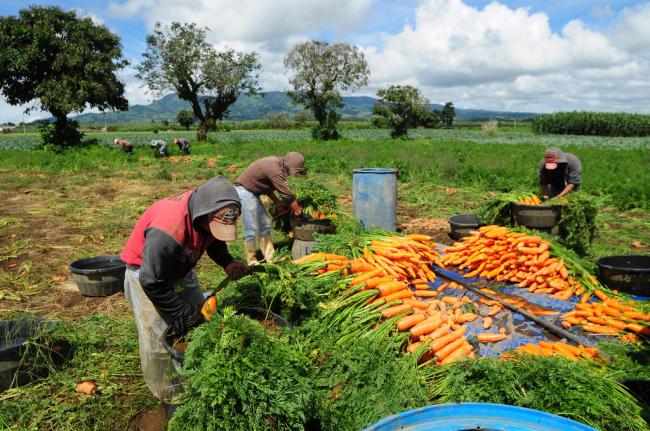
Agriculture must change, FAO chief tells Paris summit
“Since food production is not a sufficient condition for food security, it means that the way we are producing is no longer acceptable,” FAO Director-General José Graziano da Silvatold ministers, scientists, farmers, and members of civil society at the France-hosted International Forum on Agriculture and Climate Change held in Paris.
“What we are still mostly seeing is a model of production that cannot prevent the degradation of soils and the loss of biodiversity – both of which are essential goods, especially for future generations. This model must be reviewed. We need a paradigm shift,” he added.
According to the FAO, the numbers of the chronically hungry have been reduced by 100 million over the past decade, but there are still 805 million people without enough to eat on a regular basis.
Increasing production is no longer enough to end hunger. It is evident today that even though the world produces enough food to feed everyone, hunger remains a problem.
Agriculture has a large role to play in food security, building resilience to the effects of climate change and reducing humankind’s emissions of global warming gases.
“The impacts of climate change are no longer an anticipated threat. They are now a crystal-clear reality right before our eyes,” the FAO chief warned in his remarks.
He said, “Climate change will not only affect food production but also the availability of food and the stability of supplies. And in a global, interdependent economy, climate change makes the global market for agricultural products less predictable and more volatile.”
Graziano da Silva also underscored the important role played by healthy soils.
“Soils host at least one quarter of the world’s biodiversity and are key in the carbon cycle. They help us to mitigate and adapt to climate change,” he said.
2015 has been designated by the UN General Assembly as the International Year of Soils, and FAO is the lead agency for coordinating the year's activities.
One promising new approach is what is known as “climate-smart agriculture” which means adjusting farming practices to make them more adaptive and resilient to environmental pressures, while decreasing farming’s own impacts on the environment.
FAO’s Global Alliance on Climate-Smart Agriculture, established last September by the UN General Assembly, is a broad coalition of stakeholders, including governments; farmers and food producers; scientific and educational organizations; civil society actors; international agencies and the private sector.
The Alliance aims to promote increases in agricultural productivity; build greater resilience of food systems and livelihoods; and achieve reductions of greenhouse gas emissions.
The FAO Director-General also highlighted “agro-ecology” as a promising way to move food production onto a more sustainable path. The approach uses ecological theory to study and manage agricultural systems in order to make them both more productive and better at conserving natural resources.
During his visit to France, Mr. Graziano da Silva met with President François Hollande and held bilateral meetings with Laurent Fabius, France’s Minister for Foreign Affairs and International Development and Stéphane Le Foll, the country's Minister for Agriculture, Food and Forestry.
On Saturday, the Director-General is slated to participate at the opening of the Paris International Agricultural Show.
The forum, on Friday, was the first in a series of events leading up the December 2015 climate summit.
Photo: World Bank/Maria Fleischmann
Support Our Journalism
We cannot do without you.. your contribution supports unbiased journalism
IBNS is not driven by any ism- not wokeism, not racism, not skewed secularism, not hyper right-wing or left liberal ideals, nor by any hardline religious beliefs or hyper nationalism. We want to serve you good old objective news, as they are. We do not judge or preach. We let people decide for themselves. We only try to present factual and well-sourced news.
Support objective journalism for a small contribution.


