


Indian scientists refute earlier find of fossil of earliest animal in Madhya Pradesh's Bhimbetka
New Delhi: Indian scientists have proved that the Indian Dickinsonia fossil that had been originally reported from UNESCO World Heritage Site Bhimbetka Cave Shelter in earlier research in 2021, was actually a left-over impression of a fallen beehive, not a true fossil, Ministry of Science & Technology said on Friday.
The Vindhyan Supergroup, an archive of more than one billion years of history of the earth, is one the largest basins of the world and is the site of many discoveries of fossils that explain how earliest life originate and diversified on the earth.
Reporting of an Ediacaran fossil by a group of American scientists from the area encouraged a group of Ediacaran palaeontologists at BSIP curious to take a look and further hunt for another similar fossil.
This is because; Ediacaran fossils were traced to be the earliest animals that existed on the earth around 550 million years ago and hence evoke much interest among evolutionary biologists and palaeontologists. Fossil discoveries in the Precambrian Era (4000-538 million years of the earth history) claim to know about the evolutionary changes occurred in the life on the earth.
Because of their implications on our understanding of the evolution of life on the earth, many of these discoveries are followed and scrutinized by some researchers.
The group from Birbal Sahni Institute of Palaeosciences (BSIP), an autonomous institute of Department of Science and Technology, travelled to the spot of the discovery and scrutinised the fossil Dickinsonia tenuis, an important Ediacaran fossil (the earliest animal), reported from the UNESCO World Heritage Site Bhimbetka Cave Shelter in 2021.

The purported fossil from the Maihar Sandstone of Vindhyan basin was re-examined on the field to ascertain the biogenicity (chemical and/or morphological signature preserved over a range of spatial scales in rocks, minerals, ice, or dust particles that are uniquely produced by past or present organisms).
Field observations, outcrop features, and detailed laboratory analyses (XRD, Raman Spectroscopy) published in the Journal of the Geological Society of India did not support the biogenicity and syngenecity (formed at the same times as the enclosing rock) of fossil and it was inferred as a left-over impression of a fallen beehive.
The study refutes the interpretation given by renowned American researchers.
The researchers, who undertook a field study of the place where the fossil was claimed, found that, unlike fossils which are always preserved on the bedding plane of the rock strata, the sample was not entirely preserved on the bedding plane.
Part of it was preserved on the bedding plane and part of it on transversally cut face of the Maihar Sandstone outcrop. Both fresh and decayed honey beehives were observed on the same bedding plane.
A giant active beehive with several bees Apis dorsata attached to the hive was also found. Honeycomb structure was also observed.
This evidence shows that the described fossil was misinterpreted as Dickinsonia.
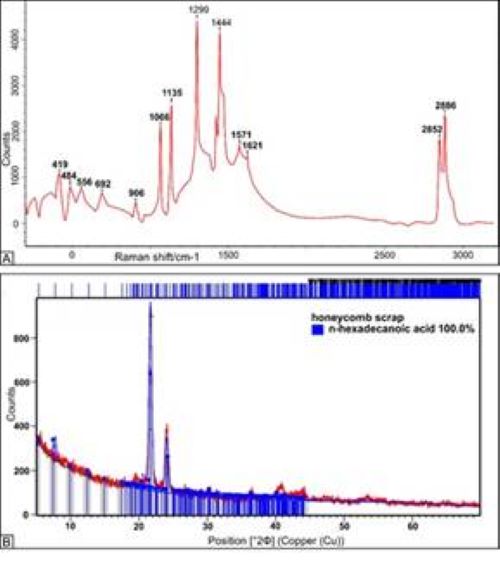
Further, Laser Raman Spectroscopy and X-Ray Diffraction (XRD) confirmed the presence of honey and wax in the material, due to the activity of bees in forming hives.
Such misinterpretations are rare, but they need to correct with due diligence for tracing the exact evolutionary trail and the correct study of Indian geology.
Publication link: https://doi.org/10.1007/s12594-023-2312-2
Support Our Journalism
We cannot do without you.. your contribution supports unbiased journalism
IBNS is not driven by any ism- not wokeism, not racism, not skewed secularism, not hyper right-wing or left liberal ideals, nor by any hardline religious beliefs or hyper nationalism. We want to serve you good old objective news, as they are. We do not judge or preach. We let people decide for themselves. We only try to present factual and well-sourced news.
Support objective journalism for a small contribution.


