


Youth policy must bridge gap between 'haves and have nots,' expert tells UN-backed forum
On the penultimate day of the First Global Forum on Youth Policy policy experts, youth activists and Government delegations gathered in Baku pressed ahead with efforts to revive commitment to ensuring the nation and international policy frameworks take into account the needs of young people and provide for their participation in decision-making, as set out in the 1995 World Programme of Action on Youth.
The United Nations Secretary-General’s Envoy on Youth Ahmad Alhendawi held talks in Baku with over 30 country representatives including from Ethiopia, Albania, Mali, Fiji, the Russian Federation, Brazil, Kuwait, Spain, Croatia, Turkey, South Africa, and others.
Briefing the UN News Centre following his meetings, Alhendawi said that while each nation faced unique challenges and aspirations, they all agreed on the urgency to address increasing youth unemployment and improve access to quality healthcare and education.
The Forum’s focus now is on reaching a consensus on what youth policy means and from that building a set of guiding principles for youth policy.
Several side events also took place on Wednesday with the goal of building partnerships among different stakeholders and bridging the gap between grassroots activists and those in Ministry halls.
At a panel discussion, a veteran youth policy expert of 40 years delivered a keynote address, saying that to this day he continues to ponder does the dialogue “down here meet the dialogue up there.”
“How do I get those points I hear from vulnerable teenagers riding the bus into the oak-paneled walls of Parliaments and into vocational strategies, drug strategies, and security strategies,” asked Howard Williamson, now a youth policy expert at the Council of Europe, one of the co-conveners of the Forum.
Williamson, who also teaches at the University of South Wales, recalled beginning his career in youth policy decades ago and put things into historic context by presenting to an audience archive documents of a United Nations youth policy from the 1960s.
“Sadly, we are still pretty bad at involving the voices of young people into the debate,” he admitted.
Youth life is inherently local but it is high-level debate that shapes issues. Countries may have a lot of committed ideas but often lack the practitioners to do the work.
“There’s always a question of access routes because even when a policy is adopted it might reach some young people in cities but neglect young people in rural areas and the country,” he said.
Youth policy financing is a critical issue as well, ranging significantly from country to country. The budgets of Norway compared to that of Latvia are very different. The same can be said comparing Asia to Africa. While mechanisms, resolutions and legislation may frame youth policy, they do “no good” without proper and adequate financing.
And even when Governments provide “packages of opportunity” it is common for resources to go to the “already privileged.” This only worsens the “youth divide.” Youth policy must narrow that gap and “level the playing field between the haves and the have nots.”
Too often criminal justice systems spend too many resources criminalizing young people who do not need to be criminalized, said Williamson.
Governments should concentrate more on positive youth policy, than regulating and sanctioning the lives of young people.
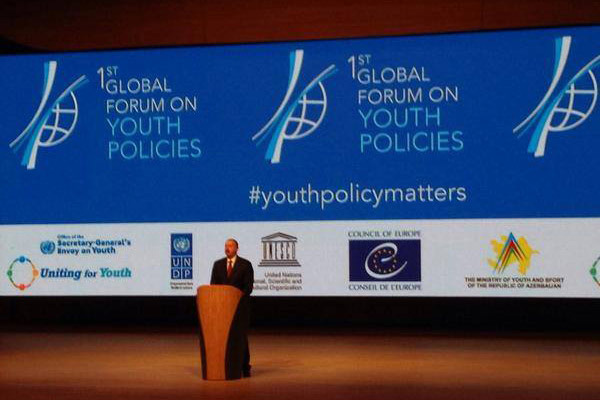
The Forum began its work on Wednesday with an inspiring address from Azerbaijan’s President, Illam Aliyev, who told a hall packed with hundreds of participants: “We are relying on the future generation.”
As a young nation, Azerbaijan knows well that equipping young people with a toolkit to tackle the future is key to sustainable development, said Aliyev highlighting how national programmes in education, sport, science and technology were “driving forces.”
Being civically active helps young people avoid falling into bad habits for example drinking, smoking and doing drugs. Emphasizing the importance of sport, the President said Azerbaijan has opened its doors to host the European Games next year, which will bring 6,000 athletes to Baku.
President Illam Aliyev of Azerbaijan addresses the Global Forum on Youth Policy. Photo: Youth Policy Forum
Support Our Journalism
We cannot do without you.. your contribution supports unbiased journalism
IBNS is not driven by any ism- not wokeism, not racism, not skewed secularism, not hyper right-wing or left liberal ideals, nor by any hardline religious beliefs or hyper nationalism. We want to serve you good old objective news, as they are. We do not judge or preach. We let people decide for themselves. We only try to present factual and well-sourced news.
Support objective journalism for a small contribution.


