


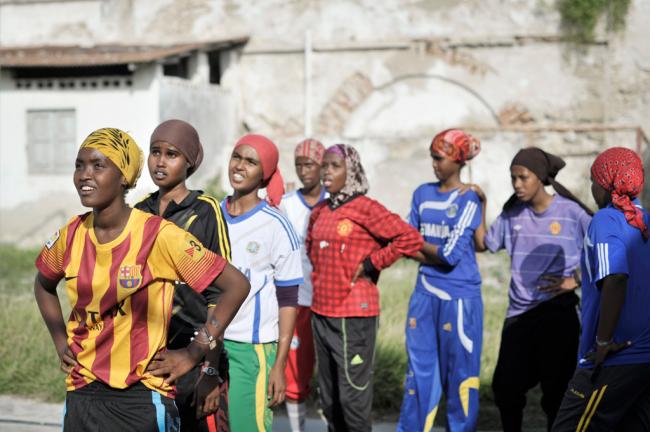
Women’s participation in sports key to boosting gender equality: UN
“Gender equality and women’s empowerment has been a marathon,” UN Women Executive Director Phumzile Mlambo-Ngcuka told a gathering at UN Headquarters.
She added, “But I hope we’re in sight of the finish line so everybody has to be a sprinter now.”
The event entitled ‘Looking ahead: the place of sport for women’s empowerment post-2015’ and held on the margins of the ongoing 59th session of the Commission on the Status of Women (CSW), underscored sports’ multidimensional role in enhancing women’s broader community engagement.
Sports programmes, the UN Women chief noted, can both fill gaps in basic nutrition and health care, bring together those who would otherwise be isolated, and tackle head-on the ever-present scourge of gender-based violence by dismantling the stereotypes of women as less capable than men.
Panellist and Olympic ice skating champion Michelle Kwan agreed, telling those in attendance that the inclusion of women in athletic activities was “not about giving a girl a ball with which to play, but about giving a girl a chance to dream.”
“When women and girls are fully able to participate in a society, all women and girls have the equal opportunity,” Kwan said.
At the same time, speaking on the merits of sports education for young girls, Werner Obermeyer, Deputy Executive Director of the UN World Health Organization (WHO), explained that team sports offered a host of physical and mental benefits for female children as it helped them build social networks and learn the “whole ethos of working together as a team.”
Beyond that, he added, athletic activities helped keep obesity levels in women down, reducing the overall costs to the health sector and the economy which otherwise would be “astronomical.”
“Through engaging in sport and living its values, women and girls can develop leadership skills, overcome bias, improve their health and become empowered,” Mlambo-Ngcuka continued.
She added, “We insist that sports must feature in the post-2015 development agenda that Heads of State and Government will adopt this coming September.”
Photo: UN Photo/Tobin Jones
Support Our Journalism
We cannot do without you.. your contribution supports unbiased journalism
IBNS is not driven by any ism- not wokeism, not racism, not skewed secularism, not hyper right-wing or left liberal ideals, nor by any hardline religious beliefs or hyper nationalism. We want to serve you good old objective news, as they are. We do not judge or preach. We let people decide for themselves. We only try to present factual and well-sourced news.
Support objective journalism for a small contribution.


