


WHO's appeal to tackle needs in four crisis-torn nations
The United Nations health agency made that call on Tuesday, on behalf the entire Health Cluster of humanitarian organizations it coordinates, at a special session at its Geneva headquarters attended by more than 50 donor countries and other Member States.
“This unprecedented number of humanitarian emergencies, combined with the Ebola outbreak response in West Africa, have demonstrated WHO’s ability to respond to major health emergencies,” Dr. Bruce Aylward, Special Representative of the Director-General for Ebola Response and Assistant Director-General for Emergencies said in a statement.
“But the huge stresses they pose also underscore the great needs – and funding gaps – that WHO, and our health partners, from NGOs to sister United Nations agencies, face,” Dr Aylward added.
All four countries for which the appeal was made are classified as so-called “Grade 3” category crises, which require the highest-level of response that the UN can deliver.
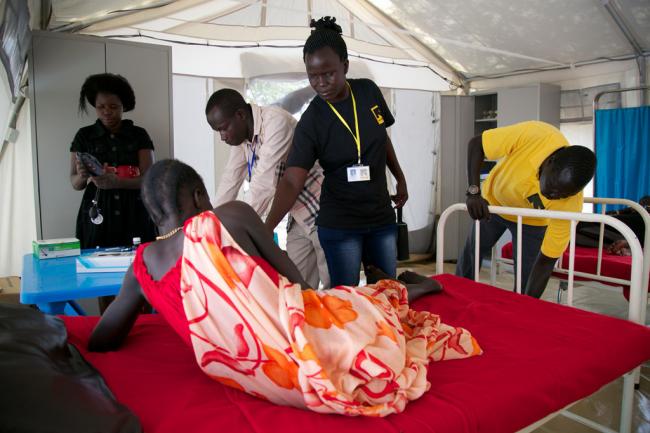
In each of the countries, the Central African Republic (CAR), Iraq, South Sudan and Syria, WHO reported that the needs range from basic health care such as childhood vaccinations to surgical care for severely wounded patients caught up in the conflicts.
“In Iraq and CAR, for example, around one-quarter of hospitals, clinics and other health facilities have been damaged in their respective conflicts, or are not functioning,” according to WHO.
“The sheer scale of humanitarian needs in 2014, coupled with insufficient funding levels, has stretched the capacity of the entire humanitarian system, including WHO, to the limit,” it added.
Overall, the Health Cluster group of humanitarian organizations needs $1 billion – $322.7 million by WHO and $687 million for its partner agencies, to deliver health services to 25 million people in the major crises, the majority women and children.
Central African Republic: 1.4 million people in need of humanitarian health support; with $48 million needed by the health sector.
Iraq: 4 million people needing humanitarian health support; $218.7 million needed by the health sector.
South Sudan: 3.3 million people needing humanitarian health support; $90 million required by the health sector.
Syria: 16.4 million people needing humanitarian health support; $687 million required by the health sector in Syria and neighbouring countries.
WHO and its partners have provided care to millions of people across each country ranging from routine immunization programmes against measles, polio and other vaccine-preventable diseases, delivering medical and health services ranging from surgical care, treating non-communicable diseases like cancers, diabetes, heart and lung diseases, and providing primary health care support to remote and besieged communities.
Photo: OCHA
Support Our Journalism
We cannot do without you.. your contribution supports unbiased journalism
IBNS is not driven by any ism- not wokeism, not racism, not skewed secularism, not hyper right-wing or left liberal ideals, nor by any hardline religious beliefs or hyper nationalism. We want to serve you good old objective news, as they are. We do not judge or preach. We let people decide for themselves. We only try to present factual and well-sourced news.
Support objective journalism for a small contribution.


