


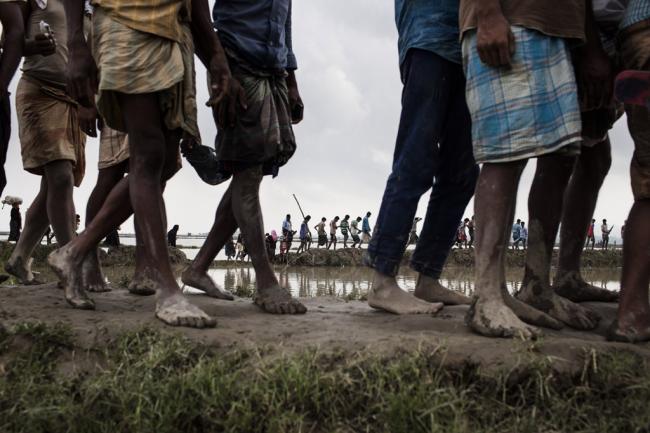
WHO appeals for international community support; warns of grave health risks to Rohingya refugees in rainy season
Dhaka, Mar 29 (IBNS): With a grossly underfunded health sector grappling to meet the needs of 1.3 million Rohingyas in Bangladesh’s Cox’s Bazar, the World Health Organization has appealed to the international community to contribute generously to enable appropriate and timely health services to this highly vulnerable population, now facing grave risks to their lives and health in view of the coming rainy season.
“This is one of the biggest humanitarian crisis in recent times. No single agency or the Government of Bangladesh alone can meet the massive health needs of such a large population group. The Rohingya population are settled in an area that is prone to cyclone, and a terrain that would be flooded as soon as rains begin. The risk of outbreak of life threatening water and vector borne diseases under such conditions is huge,” said Dr Poonam Khetrapal Singh, Regional Director, World Health Organization South-East Asia, at a meeting of partners here.
Coordinating the work of over a 100 partners on the ground along with the Ministry of Health, WHO has facilitated the contingency plan for the rainy season and coordinated a simulation around it. The plan aims at continuity of health services during rains and floods to minimize the risk of disease and deaths among the affected population. All 207 health facilities in the area have been assessed for vulnerability during rains, following which nearly 25% of them are being relocated.
Another cholera and measles vaccination campaign is being planned in April as a preventive measure for the vulnerable population. Earlier, 900,000 doses of cholera vaccine were administered to the refugees and their host communities, in addition to two vaccination campaigns for measles and three for diphtheria which concluded earlier this week with WHO support.
WHO is prepositioning medicines, medical supplies and equipment for the rainy season. Since the start of the Rohingya crisis, WHO has provided over 120 tons of supplies and logistics support to partners. WHO continues to provide critical technical support such as surveillance for epidemic prone and other diseases, collecting and sharing of information and data to enable the health sector take timely preventive / response measures and conducting preparedness trainings for the upcoming monsoons.
“However, much of the health sector’s capacity to respond depends on availability of resources,” Dr Khetrapal Singh, who visited the Rohingya camps earlier in the week, said. The rainy season is almost here, the sooner the health sector gets the funds it needs, the better would be its ability to scale up services to quickly and adequately respond to health needs of the refugees.
Besides risks posed by floods and rain, the vulnerable population would need continued services for reproductive, maternal and child health, for communicable and non-communicable diseases, as well as psychosocial support, the Regional Director said.
Earlier in Cox’s Bazar, Dr Khetrapal Singh visited the warehouse where WHO has prepositioned supplies. She observed diphtheria vaccination campaign, inaugurated a fixed immunization site where children were being administered routine immunization, and visited a primary health centre and a diphtheria treatment centre run by Samaritan's Purse.
WHO has appealed for 16.5 million USD from partners to facilitate its continued support to the Rohingya response in 2018, which is part of the 113.1 million USD being sought by all health partners together under the Joint Response Plan for the Rohingya crisis.
Support Our Journalism
We cannot do without you.. your contribution supports unbiased journalism
IBNS is not driven by any ism- not wokeism, not racism, not skewed secularism, not hyper right-wing or left liberal ideals, nor by any hardline religious beliefs or hyper nationalism. We want to serve you good old objective news, as they are. We do not judge or preach. We let people decide for themselves. We only try to present factual and well-sourced news.
Support objective journalism for a small contribution.


