


Violence spreads in Iraq; UN warns of impact on minorities
“The protection of civilians should be the primary focus of any strategy to address the current situation,” said the Special Advisers to the Secretary-General on the Prevention of Genocide, Adama Dieng, and on the Responsibility to Protect, Jennifer Welsh.
Noting that members of the Christian community are fleeing the northern city of Mosul, and reports of incitement to destroy Christian churches, the Special Advisers underlined that: “Given the context of sectarian and confessional polarization in the country, special consideration must be given to assisting religious and other minorities, which are particularly vulnerable.”
They also raised concerns about the well-being of Yazidis and other religious minorities living in north-western Iraq, following the reported capture of the town of Tal Afar.
In Thursday’s statement, Mr. Dieng and Ms. Welsh reiterated the UN Security Council’s call for cooperation in the delivery of humanitarian aid, adding that it is the role of the Government and Iraqi leaders to work with the UN Assistance Mission in Iraq (UNAMI) to ensure that aid gets to the intended people.
Meanwhile, UNAMI on Thursday reported more displacement as a result of insecurity in Mosul and surrounding areas, including Tal Afar and Diyala. UN agencies and their partners are setting up new sites and tents in Erbil, Dohuk and Suleimaniya in the northern region of Kurdistan to accommodate the growing influx of displaced families, according to a UN spokesperson.
The UN Refugee Agency (UNHCR) said last week that nearly a half-million people have fled their homes since January. At least half of them are children, the UN Children’s Fund (UNICEF) today confirmed, adding that many need water and sanitation support, immunization against polio and measles, and protection services.
“The agency has also warned that increasing risks of ethnic violence and threat to Baghdad can make the situation worse as the scale of needs and complexity of the crisis,” a spokesperson added.
Cargo planes carrying emergency supplies from UNICEF, the UN World Food Programme (WFP) and the UN World Health Organization (WHO) arrived in Erbil this week carrying supplies, including tents, blankets and schools-in-a-box, for more than 35,000 children.
Also on Thursday, WFP announced that it has started its emergency food distribution to 43,500 of the most vulnerably displaced people.
In addition, UNICEF and WHO are also working with the Kurdish health authorities to carry out a mass vaccination campaign to prevent the spread of polio and other diseases among displaced children and host communities.
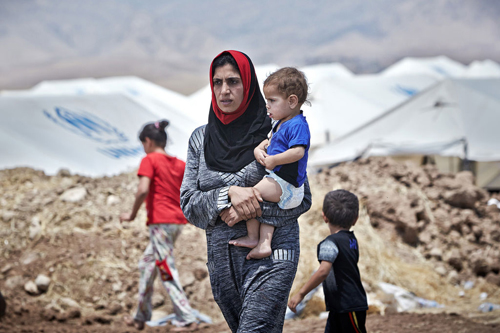
An Iraqi woman from Mosul carries her son at the Garmava transit camp, located near a checkpoint on the road between Mosul and Duhok in Iraqi Kurdistan. The camp will have the capacity to host some 3,000 people. Photo:UNHCR/S. Baldwin
Support Our Journalism
We cannot do without you.. your contribution supports unbiased journalism
IBNS is not driven by any ism- not wokeism, not racism, not skewed secularism, not hyper right-wing or left liberal ideals, nor by any hardline religious beliefs or hyper nationalism. We want to serve you good old objective news, as they are. We do not judge or preach. We let people decide for themselves. We only try to present factual and well-sourced news.
Support objective journalism for a small contribution.


