

 Myanmar
‘Urgent, renewed effort’ needed to restore civilian rule in Myanmar: Bachelet
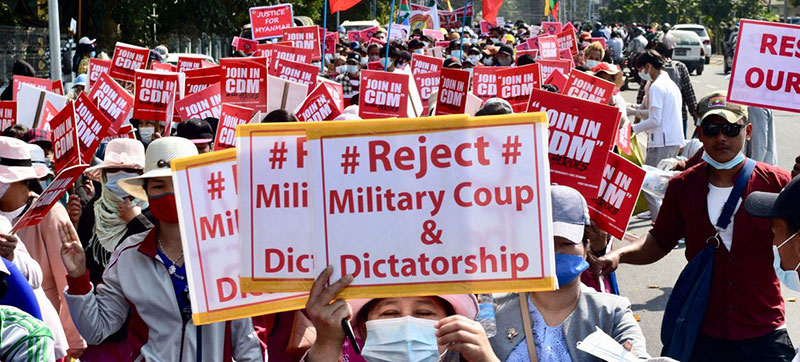
New York: UN human rights chief Michelle Bachelet appealed on Friday for the international community to intensify pressure on Myanmar’s military to stop its campaign of violence against citizens, and to insist on the prompt return to civilian rule, almost one year after seizing power in a coup.
Ms. Bachelet reported that this week she spoke in person with “determined, courageous” human rights defenders who are pleading for the international community not to abandon them, but to take robust effective measures to ensure their rights are protected and that the military is held accountable.
Heed the call
“I urge governments – in the region and beyond – as well as businesses, to listen to this plea. It is time for an urgent, renewed effort to restore human rights and democracy in Myanmar and ensure that perpetrators of systemic human rights violations and abuses are held to account,” she said.
The human rights chief said she had heard chilling accounts of violations, such as journalists being tortured; factory workers being intimidated, silenced and exploited; and intensified persecution of ethnic and religious minorities, including Rohingya.
Other reports mentioned arbitrary arrests, detentions and sham trials of political opponents; so-called “clearance operations” targeting villagers; and indiscriminate attacks including airstrikes and use of heavy weaponry in populated areas.
Despite this, “courageous human rights defenders and trade unionists continue to protest, to advocate, to document and accumulate the mounting evidence of violations,” she said.
Dissent, detention and death
Since the military takeover last February, security forces in Myanmar have moved to crush dissent, resulting in at least 1,500 deaths: a figure that excludes the thousands killed in armed conflict and violence which have intensified nationwide.
The UN human rights office, OHCHR, has documented gross human rights violations on a practically daily basis, mainly committed by security forces.
Nearly 12,000 people have been arbitrarily detained for voicing their opposition to the military, either in peaceful protests or online. Some 8,792 remain in custody, and at least 290 have died in detention, many likely due to the use of torture.
A detailed report on the human rights situation will be published in March.
Armed clashes have grown in frequency and intensity, affecting every part of the country, OHCHR said.
In areas with the highest intensity of military activity – namely Sagaing region, as well as Chin, Kachin, Kayah and Kayin states – the army has been punishing local communities for their assumed support of armed elements. The Offfice has documented village burnings, including places of worship and medical clinics, as well as mass arrests, summary executions and the use of torture.
Courage and resilience
Meanwhile, the COVID-19 pandemic, together with the collapse of the banking, transportation, education and other sectors, have exacerbated the crisis, leaving the economy on the brink of collapse.
The impacts have been devastating for Myanmar’s people. Projections indicate that nearly half of the population of 54 million could be pushed into poverty this year.
“Members of Myanmar civil society have told me first-hand what the impact of the last year has been on their lives and those of their families and communities," Ms. Bachelet said.
“The people have shown extraordinary courage and resilience in standing up for their basic human rights and support each other. Now the international community must show its resolve to support them through concrete actions to end this crisis.”
International response ‘ineffectual’
Although the coup, and the ensuing violence, have drawn near universal condemnation, Ms. Bachelet said the response has been “ineffectual and lacks a sense of urgency commensurate to the magnitude of the crisis.”
Actions on the part of the UN Security Council and regional bloc ASEAN, have been insufficient to convince the military to stop the violence and facilitate humanitarian access and aid deliveries.
Ms. Bachelet has welcomed decisions by some private corporations to withdraw from Myanmar based on human rights grounds, describing the move as a “powerful tool to apply pressure on the financing of the military’s operations against civilians.”
She stressed that the current human rights crisis is “built upon the impunity with which the military leadership perpetrated the shocking campaign of violence resulting in gross human rights violations against the Rohingya communities of Myanmar four years ago – and other ethnic minorities over many decades beforehand.”
The rights chief stated that “as long as impunity prevails, stability in Myanmar will be a fiction”, adding “accountability of the military remains crucial to any solution going forward – the people overwhelmingly demand this.”
Support Our Journalism
We cannot do without you.. your contribution supports unbiased journalism
IBNS is not driven by any ism- not wokeism, not racism, not skewed secularism, not hyper right-wing or left liberal ideals, nor by any hardline religious beliefs or hyper nationalism. We want to serve you good old objective news, as they are. We do not judge or preach. We let people decide for themselves. We only try to present factual and well-sourced news.
Support objective journalism for a small contribution.