September 21, 2026 03:36 am (IST)

Follow us:


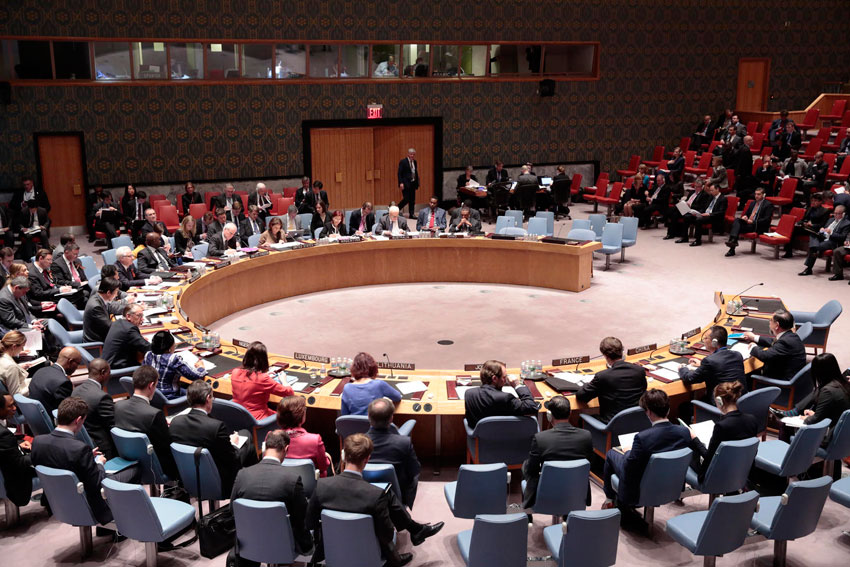
UNSC urges measures to keep chemical weapons away from terrorists
New York, May 8 (IBNS): While Governments around the world are working hard to keep weapons of mass destruction out of the hands of terrorists, a decade after adopting a landmark resolution on the issue, the United Nations Security Council (UNSC) on Wednesday said that it "remains gravely concerned by the threat of terrorism, and the risk that non-State actors may acquire, develop, traffic in or use nuclear, chemical, and biological weapons and their means of delivery."
Meeting to mark the 10th anniversary the adoption of resolution 1540, on 28 April 2004, the Council on Wednesday adopted a Presidential Statement through which its members called on all States to “step up their efforts to implement [the resolution], focusing on areas where measures taken may be strengthened, with a view to achieving full implementation of the resolution by 2021.”
By the terms of resolution 1540, the Council decided that all States shall refrain from providing any form of support to non-State actors that attempt to develop, acquire, manufacture, possess, transport, transfer or use nuclear, chemical or biological weapons and their means of delivery.
The resolution requires all States to adopt and enforce appropriate effective laws to that effect. It also requires them to develop and maintain effective border controls and law-enforcement efforts to detect, deter, prevent and combat, including through international cooperation when necessary, the illicit trafficking and brokering in such items in accordance with their national legal authorities and legislation, and consistent with international law.
More than 60 speakers are set to address the meeting, “Commemorating the 10th Anniversary of Resolution 1540 (2004) and Looking Ahead.” It was convened by the Republic of Korea, which holds the Council's rotating presidency for the month as well as the chair of the body that monitors implementation of the resolution, known by the diplomatic shorthand, “1540 Committee.”
Briefing the Council was UN Deputy Secretary-General Jan Eliasson, and the meeting was chaired by Yun Byung, Minister for Foreign Affairs of the Republic of Korea.
“Resolution 1540 has helped us make important inroads against the proliferation of nuclear, chemical and biological weapons…it has set in motion a great number of steps by Member States,” said Eliasson, noting that more than 30,000 measures and actions by States implementing the text have been reported to the 1540 Committee.
But, of course, this is only part of the story, he continued, noting that there have also been setbacks and disappointments, including the recent use of chemical weapons in Syria.
“However, through vigorous diplomatic and administrative action, and by agreement, over 90 per cent of Syria's chemical weapons have been removed from the country even as the conflict has continued and partly intensified,” said Eliasson.
He also noted that some 20 countries had not submitted a report on their implementation efforts to the 1540 Committee. In most cases, these are countries facing serious economic or social difficulties. “I encourage all Member States that have not yet done so, to submit a first report in this anniversary year of resolution 1540,” he said.
“For the resolution to work even more effectively, it must be a global commitment, a global enterprise. It is critical for every country to implement this resolution,” said Eliasson, explaining that terrorists and traffickers tend to target countries whose customs, borders, imports, exports, ports and airports are less well or poorly monitored or controlled.
One promising trend is the preparation of voluntary national implementation action plans. At the recent Nuclear Security Summit in The Hague, 32 countries released a joint statement reaffirming a commitment to submit such action plans to the 1540 Committee. It is an important step forward.
“Looking ahead, we hope to see expanded regional cooperation in implementing the resolution, especially since States sharing borders often face similar challenges,” he said, also highlighting the role of civil society in moving the world closer to meeting the goals of resolution 1540.
“And by those joint efforts we can come closer to an even more ambitious vision: a world free of all weapons of mass destruction,” declared Eliasson.
(Council Debates Non-Proliferation of Weapons of Mass Destruction. UN Photo/Evan Schneider)
Support Our Journalism
We cannot do without you.. your contribution supports unbiased journalism
IBNS is not driven by any ism- not wokeism, not racism, not skewed secularism, not hyper right-wing or left liberal ideals, nor by any hardline religious beliefs or hyper nationalism. We want to serve you good old objective news, as they are. We do not judge or preach. We let people decide for themselves. We only try to present factual and well-sourced news.
Support objective journalism for a small contribution.



Latest Headlines
Italy PM Meloni announces big school plan: Burqa, hijab ban and cap on foreign students
Sun, Sep 20 2026
North Korea fires two missiles toward East Sea, South Korea confirms
Sun, Sep 20 2026
Houthis claim Saudi F-15 shot down as Mecca drone row escalates
Wed, Sep 16 2026