


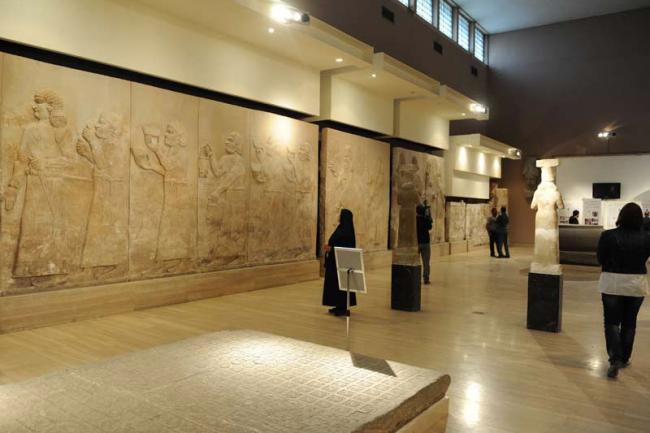
UNESCO lauds reopening of National Museum in Baghdad
Established in 1926, the Baghdad Museum dedicated to documenting and interpreting the history of Iraq and its environs, through its collections comprising objects covering the past 7,000 years, according to the UNESCO.
“It has a tremendous significance as a response to the deliberate destruction of the country’s other priceless pieces conserved in the Mosul Museum and those in the region of Nineveh, by confirming the will of the Iraqi Government and support of the international community to highlight this iconic Museum as a defense against intolerance, ignorance and violence perpetrated on the testaments of a nation’s historical past, intercultural exchange and cultural diversity,” UNESCO Director General Irina Bokova said.
The opening of the museum in Baghdad came as the UN Security Council over the weekend denounced the “deliberate destruction of irreplaceable religious and cultural artefacts” housed in Mosul Museum in a statement that strongly condemned the “ongoing barbaric terrorist acts” committed by militants of the Islamic State of Iraq and the Levant (ISIL).
Objects in the collection of the National Museum represent Sumerian, Akkadian, Assyrian, Babylonian and Islamic cultures, including in various media, including glass, pottery, metal, ivory, and parchment, according to UNESCO.
Having sustained extensive damage during the Gulf War of 1990-1991, the museum was closed until April 2000, UNESCO said in a press release. The armed conflict in March 2003 and the subsequent looting of the National Museum in April led to the loss of many of its objects from its collections.
UNESCO said he Museum management staff has estimated the number of looted items to be at approximately 15,000, including 5,000 valuable cylinder seals. According to the National Museum, 4,300 objects out of the 15,000 looted from the Museum have been returned.
Since its closing, the Iraqi authorities and UNESCO have endeavoured to coordinate international assistance to revive the National Museum, with Member States, expert communities and partners.
“Thanks to funding from Japan, the museum laboratory was restored and specialized training for staff provided,” UNESCO said.
Among the major artefacts are the Sumerian sacred vase and the masque of Warka (4th millennium BCE), the head of an Akkadian ruler from Nineveh (ca.2250-2200 BCE), an Assyrian cuneiform slab from Nimrud (first half of 1st millennium BCE), a Babylonian terracotta lion (19-18th century BCE), and a stucco panel from Samarra (9th century CE).
Photo: UNESCO
Support Our Journalism
We cannot do without you.. your contribution supports unbiased journalism
IBNS is not driven by any ism- not wokeism, not racism, not skewed secularism, not hyper right-wing or left liberal ideals, nor by any hardline religious beliefs or hyper nationalism. We want to serve you good old objective news, as they are. We do not judge or preach. We let people decide for themselves. We only try to present factual and well-sourced news.
Support objective journalism for a small contribution.


