


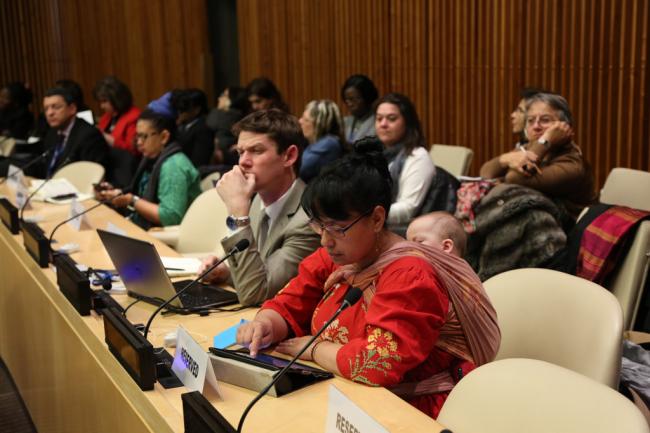
UN: Young activists for gender equality ready to play active role
“We encourage you to work with young people,” said Phumzile Mlambo-Ngcuka, Executive Director of UN Women, told the event held at UN Headquarters.
Mlambo-Ngcuka said, “Young women are leaders in their own right. They are raising the bar.”
UN Women, the agency responsible for gender equality, hosted the one-day intergenerational dialogue as a way “to galvanize the new generation of gender equality activists across various constituencies as they engage with the Beijing generation [in reference to the Fourth World Conference on Women that took place in that city 20 years ago] of civil society leaders, grassroots activists, academics, policy makers and other stakeholders.”
Lakshmi Puri, the agency’s Deputy Executive Director, called “on women and men of all ages, to really strive for the new feminist world that we all seek.”
Chebbi, the Tunisian peace activist, women’s advocate and blogger, speaking off notes from her red Mac laptop with a hot pink apple, said her generation was a bold generation and were ready to lead now.
“We are not the leaders of tomorrow, we are the leaders of today,” she said, adding that her generation had already been leading movements and non-governmental organizations, and had “kicked out dictators.”
The YWCA representative from New Zealand said she had spent 40 hours on the plane, left behind her seven-year-old child and had to miss classes in order to take part in today’s session, to appeal to the so-called “Beijing” generation to take her generation more seriously.
“We are here not just to talk but to do something,” she said, adding that her generation did not want to focus on the target set for 2030 but about what they could do this year and this decade.
Mushtak, a women’s rights activist from Pakistan, gave a TED-talk style presentation about her own experience, describing how she was made to feel like a second-class citizen and could only ride her bicycle at home and had to watch her brothers riding bicycles freely anywhere.
“I felt like a tissue paper,” she said, explaining that she felt like she could be discarded, something to be used when needed then tossed away.
Mushtak, motivated by her own experience after gaining freedom when she started living abroad, said she founded The Freedom Traveller, connecting and empowering female travellers, especially from the countries where freedom of movement for women is highly restricted.
In the wide-ranging dialogue, speaking for the need for inclusion of trans-women globally was a young Fijian trans-feminist who demanded human rights for trans-women around the world, saying “Trans-women have human rights.”
There were also a few male advocates for gender equality who spoke from countries like India and Nicaragua about the challenges they faced in promoting women and girls’ rights back home, while others spoke of the importance of educating boys to sensitize them against gender inequality.
Among those attending the dialogue were activists and advocates from the 1995 Beijing conference, contemporary women’s rights and women’s movement leaders, young women and girl leaders and organizations, feminist scholars and academics, human rights defenders and civil society organization networks including on humanitarian issues, peace and security issues, trade unions, parliamentarian unions.
Also telling the story of her years of challenges fighting gender inequality in her country, Lilian Soto, said her struggle propels her to press ahead with her presidential aspirations in Paraguay.
“Being a woman in politics means I will be in a constant struggle,” Soto said. “I need my voice to be powerful, to be heard and to make things happen.”
Photo: UN Women/Ryan Brown
Support Our Journalism
We cannot do without you.. your contribution supports unbiased journalism
IBNS is not driven by any ism- not wokeism, not racism, not skewed secularism, not hyper right-wing or left liberal ideals, nor by any hardline religious beliefs or hyper nationalism. We want to serve you good old objective news, as they are. We do not judge or preach. We let people decide for themselves. We only try to present factual and well-sourced news.
Support objective journalism for a small contribution.


