


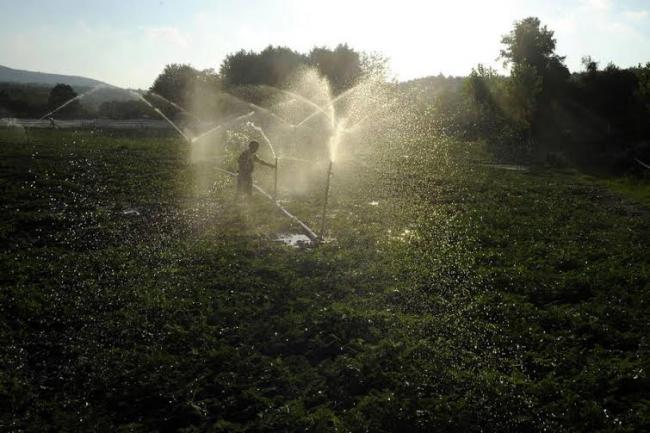
UN warns of 2050 deadline for dwindling water supplies
The report – entitled Towards a water and food secure future and launched today at the World Water Forum in concomitance with the World Water Council – urges government policies and public and private investment to ensure that crops, livestock and fish are sustainably produced in ways also aimed at safeguarding water resources.
Without such measures, the report warns, efforts to reduce poverty, increase incomes and ensure food security in many developing nations will become increasingly difficult.
“Water, as an irreplaceable element of achieving this end, is already under pressure by increasing demands from other uses, exacerbated by weak governance, inadequate capacities, and under investment,” said FAO Deputy Director-General Natural Resources, Maria Helena Semedo, in a press release marking the report's publication.
She said, “In an era of accelerated changes unparalleled to any in our past, our ability to provide adequate, safe and nutritious food sustainably and equitably is more relevant than ever.”
FAO statistics note that by 2050 some 60 per cent more food will be needed to feed the world, placing added stress on water supplies as global agriculture rushes to meet that demand.
Agriculture is already the most water-intensive industry, accounting in many countries for around two-thirds or more of supplies drawn from rivers, lakes and aquifers.
In addition, the dire straits facing the world’s water situation was recently amplified in the UN’s 2015 World Water Development report, released by the UN Educational, Scientific and Cultural Organization (UNESCO) and in time for World Water Day, marked each year on 22 March.
According to UNESCO, the planet will face a 40 per cent shortfall in water supply in 2030 unless the international community “dramatically” improves water supply management. Demand for water is slated to skyrocket 55 per cent by 2050 while 20 per cent of global groundwater is already overexploited.
Improvements to the overall outlook, however, are possible, says the FAO.
In its report, the UN agency, in fact, calls for governments to help farmers increase food output using increasingly limited water resources and empowering them to better manage risks associated with water scarcity. Moreover, water rights, the report states, need to be allocated in fair and inclusive ways.
“This is an opportune time to re-visit our public policies, investment frameworks, governance structures and institutions,” Semedo concluded.
She said, “We are entering the post-2015 development era and we should mark it with solid commitments.”
Photo: FAO/Riccardo Venturi
Support Our Journalism
We cannot do without you.. your contribution supports unbiased journalism
IBNS is not driven by any ism- not wokeism, not racism, not skewed secularism, not hyper right-wing or left liberal ideals, nor by any hardline religious beliefs or hyper nationalism. We want to serve you good old objective news, as they are. We do not judge or preach. We let people decide for themselves. We only try to present factual and well-sourced news.
Support objective journalism for a small contribution.


