


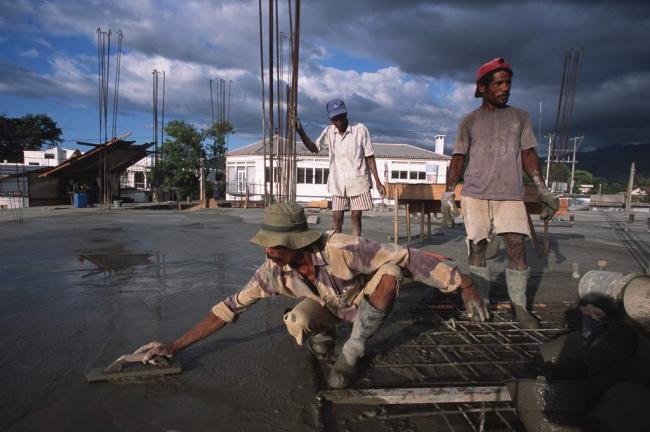
UN stresses need for employment, to achieve sustainable development
Speaking at the opening of the Economic and Social Council (ECOSOC) three-dayIntegration Segment, the Council’s Vice-President, Vladimir Drobnjak (Croatia), said ensuring sufficient employment opportunities and decent work for all people was one of the most pressing challenges faced by nations today.
“Unemployment and underemployment remain top priorities for many countries,” he said, stressing the importance of focusing on meeting the employment needs of young people.
He added, “When we brought youth delegates from all around the world for the ECOSOC Youth Forum last month, we heard time and again that unemployment tops the list of concerns for these young people.”
Drobnjak said that social protection schemes around the world fell short of protecting vulnerable people and called for full respect for international labour standards and a commitment to non-discrimination.
He said the Council had stressed the importance of inclusive and equitable economic growth in its 2012 Ministerial Declaration, which said it was important in order to accelerate progress towards the Millennium Development Goals (MDGs) and to promote sustainable development.
He looked ahead to the work that would be undertaken during the Segment, including tackling the question of how creation of decent work can help to promote the balance of the three dimensions of sustainable development. Integration of those elements was key to achieving the post-2015 development agenda.
“This is not an easy task,” he acknowledged.
He added, “It involves short-term trade-offs and long-term benefits. We will be exploring what these trade-offs are and how they are being addressed.”
Joining Drobnjak in addressing the opening of the segment were Deputy Secretary-General Jan Eliasson and Einar Gunnarsson, Permanent Representative of Iceland to the United Nations, who spoke on behalf of the President of the General Assembly.
Eliasson stressed what an “enormous and pressing” challenge States were facing as they attempted to achieve sustainable development through job creation and decent working conditions for all, pointing to several existing obstacles that needed to be overcome, including still high unemployment and underemployment.
Also, the provision of better jobs, incomes, working conditions and access to social protection, the continued existence of the informal economy and the harsher experience of conditions faced by vulnerable groups such as migrants, women, young people and people with disabilities.
“All these challenges need to be addressed if we are to build an equitable future where extreme poverty is eradicated, people are empowered and opportunity is a reality for all,” he said.
He added, “We cannot realize sustainable development without making job creation and decent working conditions for all a priority in the implementation of the post-2015 development agenda.”
Pointing to an “employment crisis” wherein young people were bearing the brunt, Eliasson said as many as 73 million young people were looking for work and were becoming increasingly frustrated.
“Their frustration is understandable and undermines belief in government and national institutions,” he said.
He added, “We must ensure that they get the relevant education and training for ‘employability.’”
In order to achieve growth that is both sustainable and inclusive, providing full and productive employment and decent work for all, Eliasson offered suggestions on how to tackle the issue.
Well-designed labour market policies would be essential in ensuring that women, youth and people with disabilities have equal access to jobs and employment opportunities, while investments should be made in a “future-oriented and green economy” to generate decent jobs, increase food security, improve public health, safeguard essential ecosystems and make cities more resilient.
Ambassador Gunnarsson, in his address on behalf of the General Assembly President, underscored that realizing the overarching objectives of the new agenda would require creation of opportunities for employment and jobs for all and he urged the international community to take “a holistic and integrated approach” to the problem.
“For many countries, especially the least developed and developing, this entails structural transformation and diversification of economies, to move away from low labour productivity sectors towards high productive sectors, such as industry and services,” he said.
He asked, “Given that agriculture is a major source of employment in many developing countries, it is crucial to improve agricultural productivity and value-addition in order to increase output and raise incomes for those employed in this sector.”
He said that a fair and rules-based trading regime was critical and an agreement overdue and he underlined the potential contribution of tourism to employment, with that sector’s linkages to many sectors of the economy.
Noting that situations vary from country to country, Gunnarsson said each Government has to take into account their own reality and identify the right mix of policies.
“We cannot have a universal blueprint or approach to creating employment and decent work for all,” he said.
He added, “At the same time, international coordination of relevant policies, such as macroeconomic and labour market policies is important. For many developing countries, attraction of foreign direct investment, transfer of technology and capacity building are crucial for transforming their economies and improving employment creation capacities.”
Photo: World Bank/Alex Baluyut
Support Our Journalism
We cannot do without you.. your contribution supports unbiased journalism
IBNS is not driven by any ism- not wokeism, not racism, not skewed secularism, not hyper right-wing or left liberal ideals, nor by any hardline religious beliefs or hyper nationalism. We want to serve you good old objective news, as they are. We do not judge or preach. We let people decide for themselves. We only try to present factual and well-sourced news.
Support objective journalism for a small contribution.


