


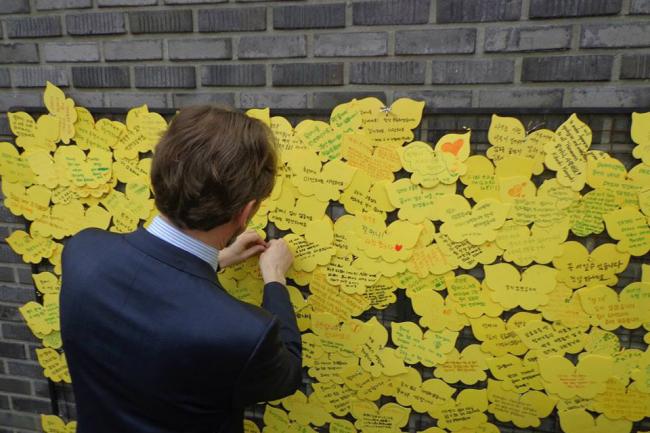
UN rights chief calls opening of office to monitor issues in DPR Korea a 'breakthrough'
“It is rare that the opening of a small office is such big news,” the High Commissioner told apress conference in Seoul, as he wrapped up a three-day visit. “While none of us expects a new UN human rights office will dramatically alter that situation overnight, we do all feel, I think, that it is a significant step.”
The new office was set up in line with a recommendation made last year by the Commission of Inquiry on Human Rights in the DPRK, whose report the UN human rights chief called “powerful, devastating and extremely influential.”
“The population of the DPRK has been suffering appalling human rights violations and deprivation for decades, and much of the outside world was barely aware of what was going on there and focussed only on the nuclear issue,” he noted, adding that the gravity, scale and nature of these violations reveal a State that does not have any parallel in the contemporary world.
“The victims now have faces and they have voices,” he went on to say.
Some of the report’s most important recommendations – such as a referral by the Security Council of the situation in the DPRK to the International Criminal Court – have not yet been acted on, but still could be, he stated.
But for him, the fact that this UN human rights office in Seoul is now a reality, and will start fully operating in a month or so, is a sign that the Commission’s work is starting to “bear fruit.”
Not only will the office monitor, report and criticize, it will also engage with civil society, refugees and defectors and with governments of the region, while keeping the UN’s channels open to the authorities in the DPRK itself.
The High Commissioner also pointed out that the Republic of Korea has undergone a highly successful transformation since becoming a democracy just over 30 years ago, rising to become the 13th largest economy in the world.
“Its performance on the human rights front has also improved significantly in parallel with its economic growth. In general, the country’s recent history makes it one of the world’s most dramatic success stories – an excellent model for countries in transition to try to emulate.”
Like even the most established democracies elsewhere in the world, the country nevertheless still faces challenges, he added.
One of the most prevalent concerns is the limitations imposed on freedom of expression and freedom of assembly by the 1948 National Security Act (NSA) which is considered by many to be long overdue for reform, he pointed out.
The vague language of Article 7 of the NSA, which refers to “anti-Government organizations” without defining what this means exactly, has in the past led to unjust and inappropriate convictions of human rights defenders and non-threatening groups – sometimes simply for comments made on social media – and is likely to continue to do so until it is amended, he explained.
“The Republic of Korea lives under constant threat from its heavily armed neighbour, and has an obligation to protect its citizens. Finding the balance between honouring the human rights of its citizens and minimizing threats to their security is difficult, but not impossible, and amending the NSA is an essential part of that process.”
Photo: OHCHR
Support Our Journalism
We cannot do without you.. your contribution supports unbiased journalism
IBNS is not driven by any ism- not wokeism, not racism, not skewed secularism, not hyper right-wing or left liberal ideals, nor by any hardline religious beliefs or hyper nationalism. We want to serve you good old objective news, as they are. We do not judge or preach. We let people decide for themselves. We only try to present factual and well-sourced news.
Support objective journalism for a small contribution.


