


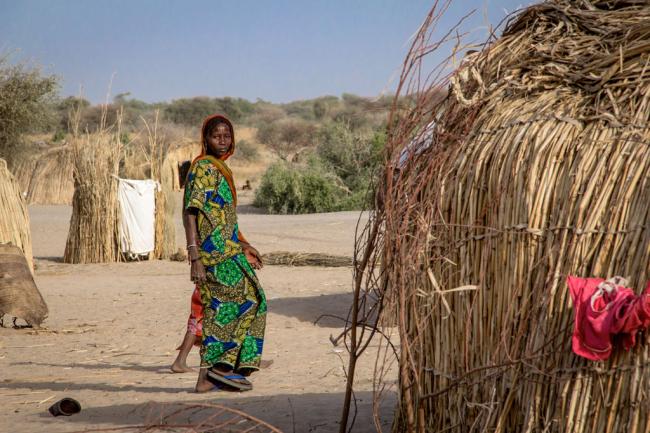
UN officials urge sustained support for humanitarian efforts in Lake Chad Basin
“We can and must help the millions of people displaced by the crisis as well as those hosting the displaced across the beleaguered Lake Chad region,” Under-Secretary-General for Humanitarian Affairs Mark Lowcock told participants at a ministerial event held on the margins of the General Assembly’s high-level session.
Lowcock, who is also UN Emergency Relief Coordinator, visited Niger and Nigeria earlier this month to raise the global profile of the Lake Chad Basin crisis, which is affecting some 17 million people in the region.
In Niger, the number of food-insecure people is around 1.8 million. Some 800,000 children are affected by acute malnutrition and almost 250,000 people are either internally displaced persons, returnees or refugees from Nigeria.
In northeast Nigeria, around 6.5 million people need life-saving assistance. Nearly 5.2 million are severely food-insecure and 450,000 children will suffer from severe acute malnutrition, this year.
The $1.1 billion appeal for the country is currently only 48 per cent funded.
“Together, we have managed to avert famine, but we cannot pause or slow down. We must continue to step up so that the millions of people who are still just a step away from starvation are not allowed to perish,” said Lowcock.
Humanitarian needs likely to remain high
Deputy Secretary-General Amina Mohammed noted that for the past eight years, Cameroon, Chad, Niger and Nigeria have suffered the horrendous consequences of the Boko Haram insurgency.
“Humanitarian needs will unfortunately remain high into next year and beyond. Sustained support is essential.”
The Deputy Secretary-General also noted that the crisis is “a powerful example” of the complex, multi-dimensional and interlinked challenges that the region faces, and shows why an integrated, comprehensive and coherent approach is needed to address the humanitarian-development nexus and its link to peace.
These challenges, she said, are driven by under-development, economic and political exclusion, environmental degradation linked to climate change, demographic shifts and structural fragility. Countries in the region are dealing with violent extremists at the same time as they are hit by economic recession and low oil prices.
“I myself grew up in Maiduguri in Nigeria – the heart of the Boko Haram insurgency,” she said. “I know better than anyone that no child is born a terrorist. Children and young people are indoctrinated and radicalized by circumstances, conditions and influences.
“Governments must act to address the root causes of violence, including the full spectrum of social, political, economic and religious grievances.”
She added that preventing crises requires investment in strengthening resilience and building the capacity of institutions and communities; investment in people and in social cohesion; reducing inequality and vulnerabilities; and expanding opportunities for all.
“The 2030 Agenda for Sustainable development is the best preventive tool we have,” she stated, referring to the 17 Sustainable Development Goals adopted by world leaders in 2015 to end poverty, reduce inequality and tackle climate change.
Credit: OCHA/Ivo Brandau
Source: www.justearthnews.com
Support Our Journalism
We cannot do without you.. your contribution supports unbiased journalism
IBNS is not driven by any ism- not wokeism, not racism, not skewed secularism, not hyper right-wing or left liberal ideals, nor by any hardline religious beliefs or hyper nationalism. We want to serve you good old objective news, as they are. We do not judge or preach. We let people decide for themselves. We only try to present factual and well-sourced news.
Support objective journalism for a small contribution.


