


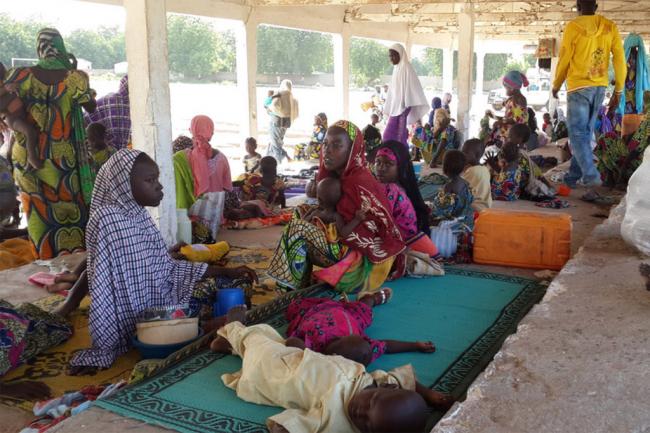
UN officials say suffering in Nigeria 'immense,' warn of regional humanitarian crisis
Briefing the press at UN Headquarters in New York, John Ging, Operations Director for the Office for the Coordination of Humanitarian Affairs (OCHA), and Afshan Khan, Director of Emergency Programmes for the UN Children’s Fund (UNICEF), reported on the growing tragedy facing civilians following their recent visit to the city of Yola, near the Nigerian-Cameroonian border.
“The people of north-east Nigeria have suffered immensely,” stated Ging.
Clashes between Boko Haram and Nigerian Government forces have intensified in recent weeks as fighting has spilled across borders and become increasingly regionalized. During the past few weeks alone, the group has also perpetrated deadly attacks against civilians in Chad, Cameroon and Niger.
Ging confirmed that more than 1 million people had already been displaced by the fighting and an estimated 6,300 civilians had been killed while countless others had suffered atrocities and violations of human rights law. Ninety per cent of those displaced, he continued, had been integrated into host communities, further burdening their services. In Yola alone, the city had doubled in population from 300,000 to 600,000 due to the influx of internally displaced persons (IDPs).
Meanwhile, the crisis was also having a dire impact on food security in the immediate region and across the Sahel, Ging said.
“With the rainy season just two months away, and host communities’ resources rapidly diminishing, we must urgently mobilize assistance to help people in need, in support of the local communities and organizations who have done so much already.”
Ging explained that the Sahel region remained “dependent” on Nigeria’s food production, receiving half of its cereals from the conflict-ridden country. Now, with agriculture disrupted by violence, the longer-term consequences of the crisis were growing in severity.
He added that OCHA was injecting $28 million dollars from its Central Emergency Response Fund (CERF) to “enable rapid surge and increase in international humanitarian action” across Niger, Cameroon, Chad and Nigeria. Nonetheless, he also called on donors to boost funding as the appeal for Nigeria remained only 8 per cent funded.
Khan voiced concern that the conflict in north-eastern Nigeria had been one of the deadliest in terms of its impact on children, with girls raped and forced into early marriage and thousands of boys forcibly recruited to fight.
She warned that women and children were suffering the bulk of the crisis, as they suffered sexual abuse and violence and were coerced to flee the zones of conflict.
“Behind these statistics and numbers are some very real stories impacting people in a very tragic way,” Khan told journalists. “Despite all they have been through, the women we met held unshakeable strength, courage and determination to rebuild their families, their communities and their country.”
The UNICEF official suggested that empowering affected women economically, in terms of a programmatic response, would help promote a positive trickle-down effect as the women, in turn, would be able to take care of their children and rebuild their lives.
“Their asks are extremely humble – protection and justice, a plot of land, an opportunity for a livelihood, free access to healthcare, and education for their children – and we must all work to support them,” she said.
Photo: UNHCR/D. Mbaoirem
Support Our Journalism
We cannot do without you.. your contribution supports unbiased journalism
IBNS is not driven by any ism- not wokeism, not racism, not skewed secularism, not hyper right-wing or left liberal ideals, nor by any hardline religious beliefs or hyper nationalism. We want to serve you good old objective news, as they are. We do not judge or preach. We let people decide for themselves. We only try to present factual and well-sourced news.
Support objective journalism for a small contribution.


