


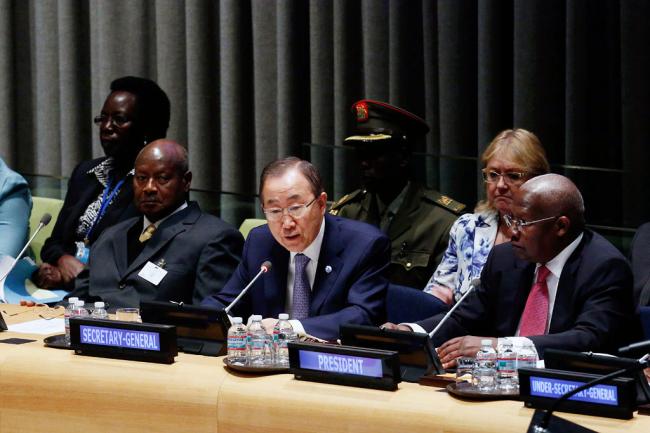
UN officials cite strengthening cooperation with regional partners as a priority
Noting that to-date, more than 25 regional and subregional organizations have established formal cooperative relationships with the United Nations, Kutesa said that “in these changing times, the distinctive role regional and subregional organizations can play in addressing some of the world’s most persistent challenges is as important as ever.”
He was speaking at the opening of the High-Level Thematic Debate on Cooperation between the United Nations and regional and sub-regional organizations, which is expected to provide Member States an opportunity to reflect on the strides made and opportunities ahead.
The debate, which featured a keynote address by Yoweri Museveni, President of Uganda, and a high-level plenary, is also expected to include two consecutive interactive panels, respectively on ‘Strengthening the strategic relationship between the UN and regional and sub-regional organizations in the areas of peace, stability and human rights’.
He also addressed ‘Galvanizing support of regional and sub-regional organizations for the implementation of a transformative post-2015 development agenda.’ The Outcome will be a negotiated Declaration.
In his remarks, Kutesa said the debate is taking place as the formulation of a universal, transformative post-2015 development agenda is underway. “Ultimately, the implementation of the new agenda will be done on the ground – in our regions, countries and communities.”
Given their in-depth understanding of their respective regions as well as their geographic proximity to challenging environments, regional and sub-regional organizations are often uniquely positioned to understand the particular local dynamics and root causes of those challenges, he said.
Also addressing the debate, the Secretary-General, who held a retreat with the heads of 18 regional and other organizations over the weekend in New York, noted that working together to promote conflict prevention and mediation has increased our powers of persuasion to press parties to make peace.
It has also reinforced collective efforts to defend human rights and uphold the values of the UN Charter.
Ban also spotlighted the importance of the UN’s cooperation with regional partners and cited as a priority the need to formulate a universal, transformative post-2015 development agenda.
Saying that “millions of lives are at stake,” the Secretary-General noted 2015 was a milestone year.
“We will complete the Millennium Development Goals,” Ban said.
He added, “We are forging a bold new vision for sustainable development, including a set of sustainable development goals. And we are aiming for a new, universal climate agreement.”
“The Ebola crisis, the tragedy of migrants dying at sea, the international drug trade, organized crime and the rise of violent extremism all show the urgent need for a collective response,” he went on to say.
“That is why I am doing everything possible to enable the United Nations, regional and subregional organizations to boost our cooperation, build on our strengths and pool our limited resources,” the UN chief declared.
Both officials also noted the progress made in the collaboration between the UN and its regional partners, but that much more remains to be done.
“We should build on the lessons of our past and current experiences to create ever more innovative and flexible partnership arrangements that draw on respective strengths, while encouraging expanded cooperation and dialogue,” Kutesa said.
And he also noted that it is “incumbent upon us to find ways of ensuring predictable and sustainable financing for regional and sub-regional organizations, especially in cases where they undertake peacekeeping operations under a UN mandate.”
Cooperation between the United Nations and regional and sub-regional organizations remains a cornerstone of the work of the United Nations as recognized in Chapter VIII of the UN Charter and numerous resolutions of the General Assembly and the Security Council.
In his wide-ranging keynote address, President Museveni said that strengthening cooperation between the UN and regional and subregional organizations would greatly benefit implementation of the psot-2015 agenda.
Indeed, due to the leverage they had within their respective countries, those organization provide useful forums for policy coordination and harmonization on various important multilateral processes.
“Regional and subregional organizations are at the centre of promoting cooperation and integration in such areas as trade and investment, infrastructure development [and] critical sectors such as agriculture, energy water and security, as well as fostering private sector partnerships,” he continued.
Museveni underscored that talk of strengthening cooperation between the UN and regional and subregional actors must begin with a re-examination of the Organization’s bodies and structures with a view to “change some of the old-fashioned ones to conform with current realities.”
Uganda strongly believed, he said, that for genuine cooperation to occur between the UN and regional and subregional organizations, reform of the Security Council in particular is imperative.
“This, in the long run, will help us, collectively to prevent the use of the UN for national or group interests of the powerful members to undermine the efforts of regional organizations and peace in the world,” Museveni declared.
Photo: UN Photo/Evan Schneider
Support Our Journalism
We cannot do without you.. your contribution supports unbiased journalism
IBNS is not driven by any ism- not wokeism, not racism, not skewed secularism, not hyper right-wing or left liberal ideals, nor by any hardline religious beliefs or hyper nationalism. We want to serve you good old objective news, as they are. We do not judge or preach. We let people decide for themselves. We only try to present factual and well-sourced news.
Support objective journalism for a small contribution.


