


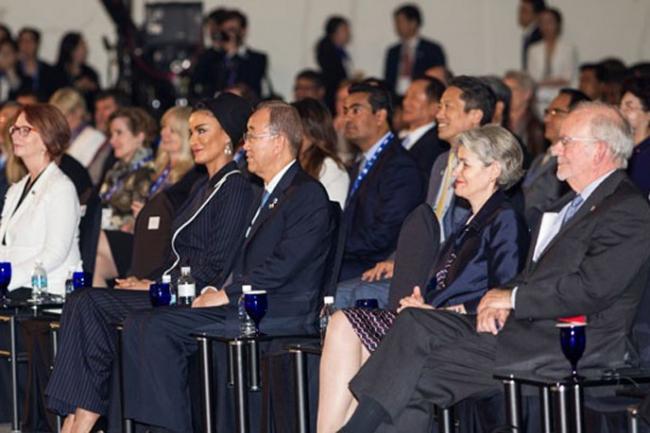
UN hails outcome of Incheon forum as ‘huge step forward’ for education
The Incheon Declaration, adopted at the World Education Forum, aims to underpin the education targets in the Sustainable Development Goals (SDGs) that will be adopted at the UN in September.
“This Declaration is a huge step forward,” said Irina Bokova, Director-General of the UN Educational, Scientific and Cultural Organization (UNESCO), in a joint press release with other UN agencies.
“It reflects our determination to ensure that all children and young people gain the knowledge and skills they need to live in dignity, to reach their potential and contribute to their societies as responsible global citizens,” she added.
She added, “It encourages governments to provide learning opportunities through life, so that people can continue to grow and develop. It affirms that education is the key to global peace and sustainable development.”
The Incheon Declaration builds on the global Education for All (EFA) movement that was initiated in Jomtien, Thailand in 1990 and reiterated in Dakar, Senegal in 2000. EFA – and the Millennium Development Goal on Education – resulted in significant progress, but many of its targets, including universal access to primary education, remain unfulfilled.
Currently, 58 million children remain out of school – most of them girls. In addition, 250 million children are not learning basic skills, even though half of them have spent at least four years in school. The Incheon Declaration seeks to finish the ambitious EFA and MDG agendas.
“If this generation of children is to someday reduce the inequalities and injustices that afflict the world today, we must give all our children a fair chance to learn.
This must be our collective vision and commitment,” said Anthony Lake, Executive Director of the UN Children’s Fund (UNICEF).
The Incheon Declaration will be implemented through the Education 2030 Framework for Action, a roadmap for governments to be adopted by the end of the year.
Effective implementation will require strong regional coordination and rigorous monitoring and evaluation of the education agenda. It will also require more funding, especially for the countries furthest from providing inclusive, quality education, forum participants said.
Also on Thursday, the UN Special Rapporteur on education, Kishore Singh, called for strategies to address inequality by focusing on girls and women, ethnic minorities, persons with disabilities and children living in conflict-affected areas, rural areas and urban slums.
“It is the weakest among us who need education the most and we cannot stand by as they are being excluded,” he said in a news release.
“Governments must safeguard education as a public good, and urgently end the commercialization of education,” Singh added.
He said, “Disparities and inequalities in society must be reduced, not encouraged. Building an inclusive education system requires governments to strengthen public education, as is their obligation under international human rights law.”
Singh called on governments to fully fund and implement their human rights obligations and bring free, public education for all. “Free basic education is the cornerstone of the right to education and must not be undermined through privatisation,” the Special Rapporteur said.
Photo: UNESCO
Support Our Journalism
We cannot do without you.. your contribution supports unbiased journalism
IBNS is not driven by any ism- not wokeism, not racism, not skewed secularism, not hyper right-wing or left liberal ideals, nor by any hardline religious beliefs or hyper nationalism. We want to serve you good old objective news, as they are. We do not judge or preach. We let people decide for themselves. We only try to present factual and well-sourced news.
Support objective journalism for a small contribution.


