


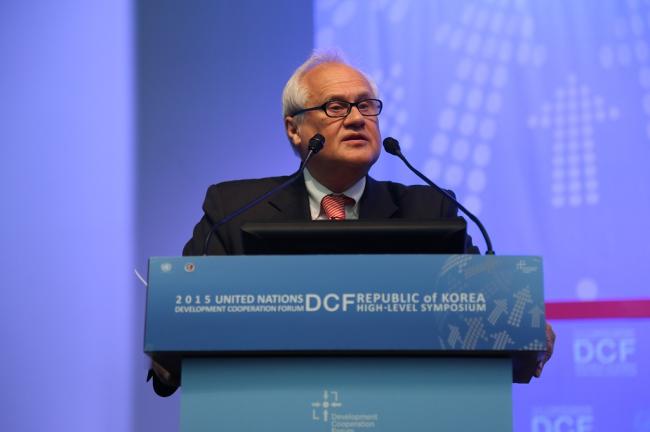
UN forum seeks answers to questions on sustainable development reality
Such means of implementation for the development agenda, which can come from many private, public, national and international sources, will be vital once the world adopts its new saustainable development plan for the next 15 years.
“A unique, unparalleled in history, path forward is taking shape, with the crafting of a transformative, unified and universal post-2015 development agenda, focused on poverty eradication and sustainable development,” said ECOSOC President Martin Sajdik (Austria).
He added, “There is broad consensus that the agenda's successful implementation will depend on a comprehensive financing framework for sustainable development.”
The Forum, held under the slogan, 'Development cooperation for people and planet: What will it take?' brought together leaders from Government, the private sector, academia and civil society for a three-day high-level symposium to grapple with the topic.
The event aims to generate concrete ideas and policy recommendations to explore how to deliver 'the future we want' – an economically, socially and environmentally sustainable future for our planet and for present and future generations.
As well as ensuring availability of means of implementation, Sajdik said that success of the new agenda would also hinge upon the effective review of progress on substantive goals and follow-up to commitments made, especially on the full spectrum of means of implementation – financial and other, from capacity building to technology transfer.
“This requires a flexible, multi-layered global framework,” he said.
He added, “It must build on existing mechanisms at all levels, following a bottom-up approach.”
The symposium comes as countries are gearing up for the Financing for Development Conference in Addis Ababa this July, the Sustainable Development Summit in New York, and climate negotiations in Paris.
The DCF high-level symposium is geared to produce new ideas and policy recommendations into the preparations of the summits.
While underlining the importance of preparations for the Addis Ababa Conference to ensure its outcomes were fully integrated into the negotiations on the post-2015 agenda, Sajdik added that development cooperation embraces practices that involve both financial and non-financial means of implementation.
“It has to be more at the centre of a coherent narrative, vision and concerted action for the realization of the new agenda,” he said.
He added, “Development cooperation is a vital part of the broader global partnership for sustainable development needed to bring about the systemic policy changes for all partners to come closer together and make progress, to leave no one behind, to tackle common global problems and take up opportunities to put the world on a firm path toward sustainable development for all.”
Photo: Government of Republic of Korea
Support Our Journalism
We cannot do without you.. your contribution supports unbiased journalism
IBNS is not driven by any ism- not wokeism, not racism, not skewed secularism, not hyper right-wing or left liberal ideals, nor by any hardline religious beliefs or hyper nationalism. We want to serve you good old objective news, as they are. We do not judge or preach. We let people decide for themselves. We only try to present factual and well-sourced news.
Support objective journalism for a small contribution.


