


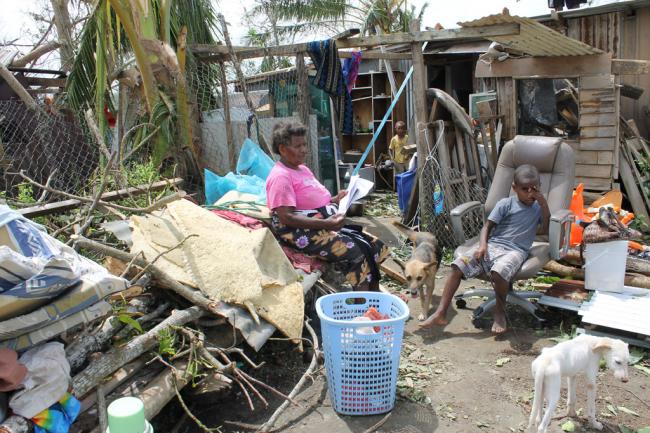
UN focuses on priority needs for cyclone-hit Vanuatu
A UN Disaster Assessment and Coordination (UNDAC) team arrived in the Pacific Ocean archipelago yesterday and began its work in supporting the Government of Vanuatu in coordinating the humanitarian response to Cyclone Pam.
“The communication infrastructure is in poor condition, causing difficulties in the humanitarian coordination. However, the Government is clearly in charge of the response and President Baldwin Lonsdale has asked for international assistance,” Jens Laerke, spokesperson for the UN Office for the Coordination of Humanitarian Affairs (OCHA), told anews conference in Geneva.
The World Food Programme (WFP) is working to support the response in all areas of its mandate, including emergency food assistance, logistics and telecommunications interventions.
“While there did not appear to be a need for the WFP to bring in large quantities of food assistance at present, WFP had been asked to provide logistics support for management of relief items, technical assistance in organising food distributions, and IT support,” spokesperson Elisabeth Byrs stated.
She added that the agency has contingency stocks of High-Energy Biscuits on standby and ready to be airlifted into the country if necessary.
Byrs noted that the Government has requested satellite equipment to facilitate communication between the islands, as well as support to set up communications systems to coordinate the humanitarian response.
The UN International Telecommunication Union (ITU), for its part, said today it has dispatched emergency telecommunications equipment to Vanuatu following the devastation caused by the cyclone. At the request of the Government, ITU has sent 40 satellite phones, 10 Broadband Global Area Network terminals, and 35 solar panels to support relief coordination efforts.
Noting that over 80 per cent of the population in Vanuatu is engaged in agriculture, Byrs said that different assistance would be needed to support those who have suffered losses in the agricultural sector, which had been severely affected by the storm.
This included destruction of the banana crop and most coconut trees, loss of vegetable and fruit crops, destruction of small livestock and fishing infrastructure, as well as loss of food and seed stocks.
Coconut plantations, which are the key agricultural commodity in the country, are likely to have been severely damaged, she added. Given the heavy reliance of communities on coconuts and coconut products, impact on livelihoods is likely to be long-lasting.
Fishing is a key livelihood in coastal areas, and it might now have been disrupted due to severe winds resulting in loss of fishing boats and other assets.
Meanwhile, the country’s Ministry of Health today began a measles prevention campaign with support from UN Children’s Fund (UNICEF) and the World Health Organization (WHO).
This is critically important given the low routine immunisation rates and a recent measles outbreak in early March, according to a news release on the campaign, the purpose of which is to prevent a measles epidemic in a population made doubly vulnerable by low immunisation coverage and the cyclone disaster.
UNICEF is also distributing health supplies for children and families affected by the cyclone, including basic health kits, oral rehydration salt sachets, zinc tablets, vitamin A capsules, and de-worming tablets.
The agency has also donated tents, school backpacks with school supplies, recreation kits, hygiene kits, water tanks, soap for hand washing, collapsible water containers and water purification tables.
According to the World Meteorological Organization (WMO), Cyclone Pam – which also impacted the Solomon Islands, Kiribati and Tuvalu – had been one of the most powerful cyclones to make landfall, with winds having been estimated to have reached 250 km/hr with gusts of 320 km/hr.
“Its maximum speed had been more than enough to lift an airplane when it had made a direct hit on the capital, Port Vila,” WMO’s Clare Nullis told reporters in Geneva.
She noted that the early warnings issued by WMO’s Regional Specialized Meteorological Centre in Fiji and by local meteorological services had indeed been accurate. “Without those warnings, the loss of life would have been much greater. Nonetheless, the intensity of the storm had been such that it had caused a lot of material damage.”
Photo: UNICEF/Graham Crumb
Support Our Journalism
We cannot do without you.. your contribution supports unbiased journalism
IBNS is not driven by any ism- not wokeism, not racism, not skewed secularism, not hyper right-wing or left liberal ideals, nor by any hardline religious beliefs or hyper nationalism. We want to serve you good old objective news, as they are. We do not judge or preach. We let people decide for themselves. We only try to present factual and well-sourced news.
Support objective journalism for a small contribution.


