


UN declares Ebola public health emergency over; urges 'high vigilance' against flare-ups
The Emergency Committee convened by WHO Director-General Margaret Chan concluded at its ninth meeting that the Ebola situation in West Africa no longer constitutes a public health emergency of international concern and that the temporary recommendations adopted in response should now be terminated.
“I have accepted the Committee's advice,” Chan said, noting however that a high level of vigilance and response capacity must be maintained to ensure the ability of the countries to prevent Ebola infections and to rapidly detect and respond to flare-ups in the future.
Each of the recent flare-ups was immediately and effectively contained.
“Ebola response capacity in West Africa is strong,” she said, stressing that the three most-affected countries – Guinea, Liberia, and Sierra Leone – now have the world's largest pool of expertise in responding to Ebola.
WHO has kept hundreds of its own experienced staff in the three countries, ready to contribute to the kind of emergency response needed to quickly interrupt transmission chains, and for the first time in any Ebola outbreak, response teams have access to vaccination as a powerful containment tool, she added.
With the number of cases now much smaller, WHO's laboratory partners are able to sequence viruses from individual patients. Sequence data on individual viruses back up the epidemiological detective work needed to define the source of transmission chains with great precision.
The Committee experts supported WHO's view that more small clusters of cases can be expected, but concluded that existing national and international response capacity is sufficient to contain new clusters of cases quickly, and the likelihood of international spread by air travel is extremely low, she said.
Ebola killed more than 11,000 people since its outbreak in December 2013.
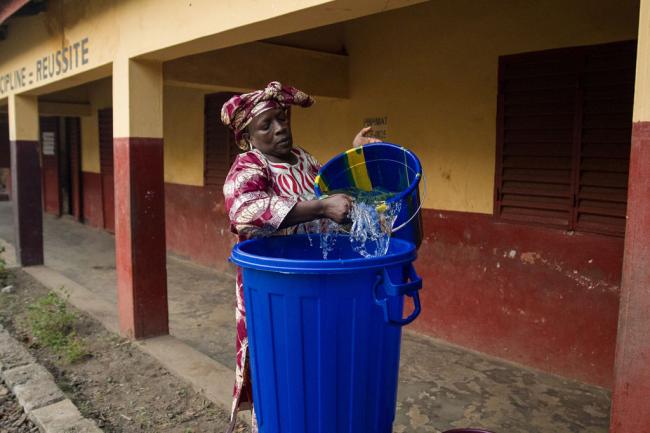
Photo: UNMEER/Martine Perret
Support Our Journalism
We cannot do without you.. your contribution supports unbiased journalism
IBNS is not driven by any ism- not wokeism, not racism, not skewed secularism, not hyper right-wing or left liberal ideals, nor by any hardline religious beliefs or hyper nationalism. We want to serve you good old objective news, as they are. We do not judge or preach. We let people decide for themselves. We only try to present factual and well-sourced news.
Support objective journalism for a small contribution.


