


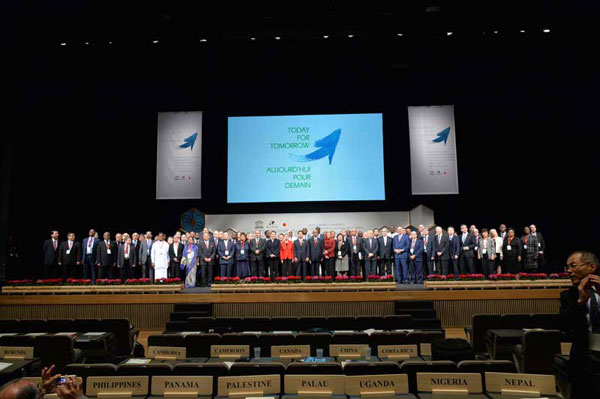
UN conference adopts declaration calling for urgent action on education for sustainable development
The Aichi-Nagoya Declaration calls on all nations to implement the Global Action Programme on ESD to move the relevant agenda forward.
In his closing remarks, Qian Tang, who is Assistant Director-General for Education at the UN Educational, Scientific and Cultural Organization (UNESCO) – a conference co-organizer along with Japan – said the declaration is instrumental in helping streamline education in national post-2015 development agendas.
“We were able to share successful initiatives from all over the world, to help government representatives and other key stakeholders formulate new goals and objectives. We have shaped these into a Roadmap for ESD that will implement the Global Action Programme,” Mr. Tang said.
More than 1,000 participants gathered for the three-day conference under the theme “Learning Today for a Sustainable Future.”
Among them were 76 ministerial-level representatives of UNESCO Member States, non-governmental organizations, academia, the private sector and UN agencies, as well as individual experts and youth participants from 150 countries.
The Action Plan is a follow up to the UN Decade of ESD, which is ending this year. It will generate and scale up ESD actions in each of five priority areas of policy support, whole –institution approaches, educators, youth, and local communities.
UNESCO has called on stakeholders to make specific contributions to launch the GAP. Stakeholders from 80 countries have responded with 363 commitments.
The Aichi-Nagoya Declaration adopted unanimously today, builds on the achievements of the Decade and the deliberations and stakeholder meetings which were held last week in Okayama.
The Declaration also ensures that the outcomes of the Conference will be taken into account at the World Education Forum 2015 to be held in Incheon, Republic of Korea.
Representing the host country, Japan’s State Minister of Education, Culture, Sports, Science and Technology, Hideki Niwa said “ESD will not end with the last year of the Decade of ESD. Instead let us recharge our efforts for ESD with even greater commitment, making the most of the experiences we have gained so far.”
Group photo at the UNESCO World Conference on Education for Sustainable Development (ESD) in Aichi-Nagoya, Japan. Photo: UNESCO
Support Our Journalism
We cannot do without you.. your contribution supports unbiased journalism
IBNS is not driven by any ism- not wokeism, not racism, not skewed secularism, not hyper right-wing or left liberal ideals, nor by any hardline religious beliefs or hyper nationalism. We want to serve you good old objective news, as they are. We do not judge or preach. We let people decide for themselves. We only try to present factual and well-sourced news.
Support objective journalism for a small contribution.


