


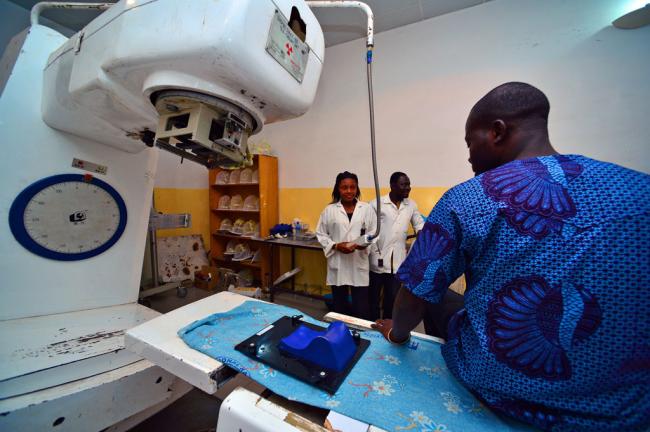
UN atomic agency co-hosts international meeting on cancer in developing countries
“The rising tide of cancer calls for additional human and financial resources, as well as infrastructure,” Nelly Enwerem-Bromson, Director of the Programme of Action for Cancer Therapy at the UN International Atomic Energy Agency (IAEA) said at the meeting in the Sudanese capital of Khartoum. He spoke alongside Sudanese Vice-President Hassabo Mohammed Abdalrahman, who opened the meeting.
The event, co-organized by the IAEA and the Sudanese Government, brought together health and finance representatives from 16 Governments to discuss their funding proposals on how to better detect and treat breast and cervical cancer, and develop nuclear medicine and radiotherapy as part of national cancer control programmes.
Each year, 8.8 million people die from cancer, mostly in low- and middle-income countries, according to figures from the World Health Organization (WHO). The figure is so high that is accounts for two and a half times more people killed than those who die from HIV/AIDS, tuberculosis and malaria combined.
Cervical cancer is particularly deadly and disproportionally affects women in developing countries, where 83 per cent of all new cases occur, IAEA reported.
One of the plans discusses proposes to establish a permanent screening centre in Cameroon, where 1,400 new women are diagnosed with cervical cancer each year, and 700 die.
The meeting also reviewed a proposal to expand cancer services for low-income people in Jordan, including refugees. The only public radiotherapy facility is in the capital, Amman, which treats around 50 patients per day.
The Governments represented at on Wednesday's meeting are members of the IAEA, the Organization of Islamic Cooperation (OIC), and the Islamic Development Bank.
Other institutions present included the African Development Bank, the Arab Bank for Economic Development in Africa and the WHO.
Photo: IAEA
Source: www.justearthnews.com
Support Our Journalism
We cannot do without you.. your contribution supports unbiased journalism
IBNS is not driven by any ism- not wokeism, not racism, not skewed secularism, not hyper right-wing or left liberal ideals, nor by any hardline religious beliefs or hyper nationalism. We want to serve you good old objective news, as they are. We do not judge or preach. We let people decide for themselves. We only try to present factual and well-sourced news.
Support objective journalism for a small contribution.


