


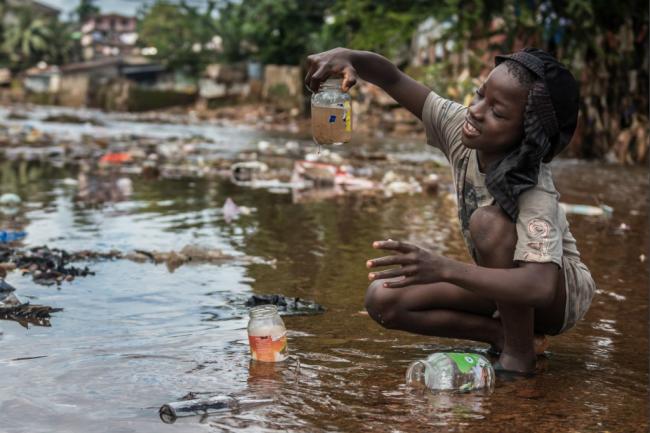
UN and partners aim to slash 90 per cent of cholera deaths by 2040
“This is a disease of inequality that affects the poorest and most vulnerable. It is unacceptable that nearly two decades into the 21st century, cholera continues to destroy livelihoods and cripple economies,” said Tedros Adhanom Ghebreyesus, Director-General of the World Health Organization (WHO).
With an estimated 95,000 cholera-related deaths, and another 2.9 million more people affected annually, the Global Task Force on Cholera Control (GTFCC), a diverse network of more than 50 UN and international agencies, academic institutions and others, will launch tomorrow ‘Ending Cholera: A Global Roadmap to 2040, which pinpoints endemic ‘hotspots’ where predictable cholera outbreaks occur year after year.
“WHO is proud to be part of this new joint initiative to stop deaths from cholera. This roadmap is the best way we have to bring this to an end,” said Tedros Adhanom.
Urgent action is needed to protect communities, prevent transmission and control outbreaks.
The ‘Global Roadmap’ aims to align resources, share best practice and strengthen partnerships between affected countries, donors and international agencies. It underscores the need for a coordinated approach to cholera control with country-level planning for early detection and response to outbreaks. Through its implementation, up to 20 affected countries could eliminate cholera by 2040.
“Every death from cholera is preventable with the tools available on Tuesday, including use of the oral cholera vaccine and improved access to basic safe water, sanitation and hygiene as set out in the Roadmap,” underscored the WHO chief.
Although access to water and sanitation is recognized as a UN basic human right, on Tuesday over two billion people worldwide still lack access to safe water and are potentially at risk of cholera. Weak health systems and low early detection capacity further contribute to the rapid spread of outbreaks.
Cholera disproportionally impacts communities already burdened by conflict, lack of infrastructure, poor health systems, and malnutrition. Protecting these communities before cholera strikes is significantly more cost-effective than continually responding to outbreaks. The introduction of the oral cholera vaccine has been a game-changer in the battle to control cholera – bridging the gap between emergency response and longer-term control.
With two WHO-approved oral cholera vaccines now available, for just $6 per person, individuals can be fully vaccinated for up to three years of protection.
The ‘Global Roadmap’ provides an effective mechanism to synchronize the efforts of countries, donors, and technical partners and underscores the need for a multi-sectoral approach to cholera control with country-level planning for early detection and response to outbreaks.
“We must act together. And we must act now,” asserted Tedros.
Photo: WHO/Acland
Source: www.justearthnews.com
Support Our Journalism
We cannot do without you.. your contribution supports unbiased journalism
IBNS is not driven by any ism- not wokeism, not racism, not skewed secularism, not hyper right-wing or left liberal ideals, nor by any hardline religious beliefs or hyper nationalism. We want to serve you good old objective news, as they are. We do not judge or preach. We let people decide for themselves. We only try to present factual and well-sourced news.
Support objective journalism for a small contribution.


