


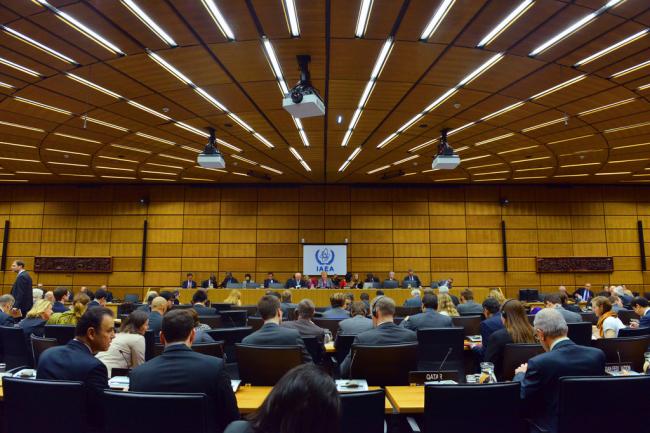
UN agency stresses role of nuclear energy in development
The International Atomic Energy Agency (IAEA) Director General Yukiya Amano said the Vienna-based body remains ready to play an essential role in verifying the DPRK’s nuclear programme, despite DPRK’s unwillingness to allow verification teams into the country.
“It is nearly six years since Agency inspectors were asked to leave the DPRK,” he said.
He added, “I call upon the DPRK to comply fully with its obligations under relevant Security Council resolutions, to cooperate promptly with the Agency in implementing its NPT (Treaty on the Non-Proliferation of Nuclear Weapons) Safeguards Agreement, and to resolve all outstanding issues.”
Verification of the non-diversion of nuclear material by Iran continued under the Safeguards Agreement was continuing, Amano said, monitoring and verification in relation to the nuclear-related measures set out in the Joint Plan of Action agreed between Iran and the so called “E3+3” countries (China, France, Germany, Russia, United Kingdom and United States).
“The Agency is not in a position to provide credible assurance about the absence of undeclared nuclear material and activities in Iran,” he said adding that that meant it was therefore impossible to conclude that all nuclear material was being used peacefully.
The Agency was unable to clarify two outstanding practical measures that were agreed last year under the Framework for Cooperation, while Iran was still to propose new practical measures. With increased cooperation by Iran, the Agency could help to accelerate resolution of all outstanding issues under the Framework, and he called for timely provision of access to all information, documentation, sites, material and personnel requested by the Agency.
“This process cannot continue indefinitely,” he said.
He added, “Once the agency has established an understanding of the whole picture concerning issues with possible military dimensions, I will provide a report with our assessment to the Board.”
Pointing to positive recent meetings with Iran’s Foreign Minister, Mohammad Javad Zarif, and his Deputy Araghchi, Amano reported that he had no new developments to report on implementation of safeguards in Syria and he renewed his call on Syria to cooperate fully in connection with unresolved issues related to the Dair Alzour site and other locations.
While stressing the importance of nuclear safeguards, Amano also underlined the importance of the Agency’s work to make nuclear technologies available for development.
“I feel that our mandate could be understood today not just as ‘Atoms for Peace,’ but as Atoms for Peace and Development,” he said, emphasising the importance of modern science and technology, including nuclear technology, for development, and calling for its appropriate recognition in the post-2015 development agenda.
He also drew attention to progress in implementation of the IAEA Action Plan on Nuclear Safety, including adoption of the Vienna Declaration on Nuclear Safety including principles for the implementation of the Convention to prevent accidents with radiological consequences and to mitigate such consequences should they occur.
Noting that the Agency was moving into a “critical period” as far as extra-budgetary contributions for the ReNuAL project to modernise the nuclear applications laboratories at Seibersdorf are concerned, he said it was “worrying” that no concrete commitments of contributions towards the cost of construction of the buildings have been received so far, although some Member States have indicated strong interest.
Photo: IAEA/Dean Calma
Support Our Journalism
We cannot do without you.. your contribution supports unbiased journalism
IBNS is not driven by any ism- not wokeism, not racism, not skewed secularism, not hyper right-wing or left liberal ideals, nor by any hardline religious beliefs or hyper nationalism. We want to serve you good old objective news, as they are. We do not judge or preach. We let people decide for themselves. We only try to present factual and well-sourced news.
Support objective journalism for a small contribution.


