


UN agency hails Suriname for eliminating gender discrimination in nationality laws
The important amendment to the 1975 Law on Nationality and Residence ensures gender equality in nationality laws and brings these laws into compliance with international standards, noted a news release issued by the UN High Commissioner for Refugees (UNHCR).
The changes, including the right of women to confer their nationality to their spouses, will provide important safeguards to eliminate gender discrimination and prevent statelessness due to loss of nationality, UNHCR stated.
A gap in the previous nationality law meant that a child born in wedlock abroad could not acquire nationality from its mother. This could lead to statelessness in cases where children could not acquire nationality from their foreign fathers.
UNHCR noted that while nationality laws can be complex, reforms to incorporate gender equality can often be achieved through relatively simple changes to the formulation of relevant legislative provisions.
There is a growing willingness and commitment by States to ensure gender equality in nationality laws. Suriname joins Algeria, Bangladesh, Egypt, Indonesia, Kenya, Monaco, Morocco, Senegal, Tunisia, Yemen and Zimbabwe to become the 12th country in the past 10 years to have enacted reforms to ensure gender parity in its nationality laws.
A number of these States, along with UNHCR and UN Women, are also actively supporting the recently launched International Campaign to End Gender Discrimination in Nationality Laws. The initiative aims to incorporate gender equality in legislation.
Currently, women in 27 countries still do not have the rights to confer nationality to their children on an equal basis as fathers. In over 60 countries, laws do not allow women to acquire, change or retain their nationality equally with men, leaving them and their foreign spouses vulnerable to statelessness.
The campaign advances advocacy, training and research initiatives and leads up to the Campaign to End Statelessness, to be launched by UNHCR in September 2014. The agency also encourages Suriname to accede to the UN Statelessness Conventions as part of this campaign.
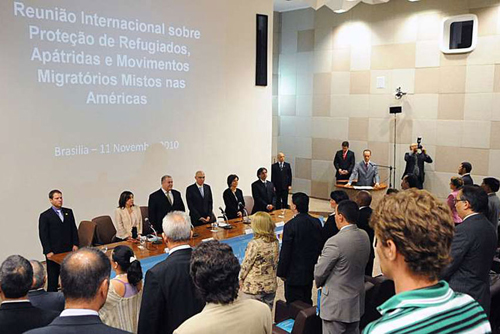
Latin America nations pledge more for protection of the displaced and stateless (file photo). Photo: UNHCR
Support Our Journalism
We cannot do without you.. your contribution supports unbiased journalism
IBNS is not driven by any ism- not wokeism, not racism, not skewed secularism, not hyper right-wing or left liberal ideals, nor by any hardline religious beliefs or hyper nationalism. We want to serve you good old objective news, as they are. We do not judge or preach. We let people decide for themselves. We only try to present factual and well-sourced news.
Support objective journalism for a small contribution.


