


UN agencies urge greater support to fight mounting hunger crisis in Africa's Sahel region
Terrorism, weak governance and recurrent droughts in Africa’s Sahel have only exacerbated the food insecurity crisis in the region, officials from the Food and Agriculture Organization (FAO) and the Office for the Coordination of Humanitarian Affairs (OCHA) said in a joint statement.
“If we are going to break out of this cycle of chronic crises across the Sahel region, emergency assistance to vulnerable farmers and pastoralists has to be considered a top priority,” said Robert Piper, the UN Regional Humanitarian Coordinator for the Sahel. “The best way to reduce on Saturday’s emergency caseload is to help households protect their assets on Friday,” he added.
In February, FAO appealed to donors for $116 million to assist more than 7.5 million vulnerable people in the Sahel. To date, only $16 million, or less than 14 per cent, have been received. That staggering funding gap of $100 million is severely hampering the fight against hunger.
“Due to funding gaps, interventions that could prevent the food security situation from worsening are delayed and the capacities of vulnerable communities to cope with repeated shocks are deteriorating,” said Bukar Tijani, FAO’s Assistant Director-General and Regional Representative for Africa.
“More should be done to protect the lives and livelihoods of vulnerable communities in a region that is so frequently affected by various shocks,” he urged.
Refugees fleeing ongoing conflict in the Central African Republic and Nigeria are seeking shelter in neighbouring countries and require urgent food assistance. Even more alarming, the FAO said, the rainy season has so far been patchy, with below-average precipitation registered in parts of the region, delaying planting activities in Senegal and Chad. To meet refugee needs, host families are using their own food reserves, which are already limited.
Recent clashes in northern Mali have also generated new displacements to the south of the country as well as to neighbouring countries. Refugees are fleeing with their cattle, putting additional pressure on natural resources and cultivated areas, thus increasing the risk of conflict between communities. Poor rural households are often faced with very difficult decisions namely to sell their only assets, reduce the number of meals or take children out of school.
“With timely donor support, FAO still can prevent further degradation of livelihoods and missed planting opportunities for many vulnerable communities, while at the same time strengthening their resilience with longer-term interventions,” Tijani said.
This year the UN and its humanitarian partners launched an ambitious three-year Regional Strategic Response Plan for the Sahel to support resilience over the longer term by tackling the root causes of hunger. The plan also includes scaling-up measures to meet the immediate food security and nutritional needs of the hungry. Funds, however, are desperately needed to carry out this plan.
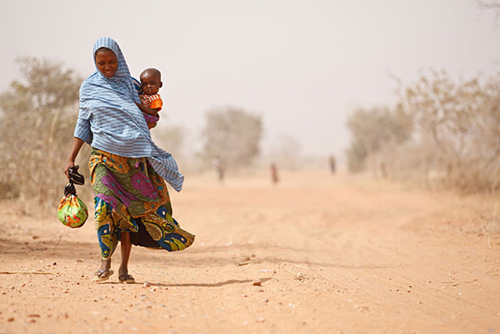
A woman and her severely malnourished son leave a UNICEF-supported health centre, in Maradi Region. Photo: UNICEF/Olivier Asselin
Support Our Journalism
We cannot do without you.. your contribution supports unbiased journalism
IBNS is not driven by any ism- not wokeism, not racism, not skewed secularism, not hyper right-wing or left liberal ideals, nor by any hardline religious beliefs or hyper nationalism. We want to serve you good old objective news, as they are. We do not judge or preach. We let people decide for themselves. We only try to present factual and well-sourced news.
Support objective journalism for a small contribution.


