


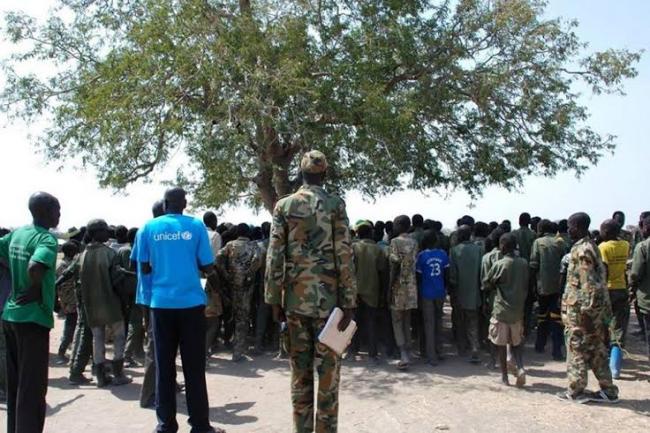
South Sudan: UNICEF celebrates ongoing demobilization of child soldiers
“For every child released, it’s the chance for a new life,” UNICEF South Sudan Representative Jonathan Veitch stated in a press release issued earlier on Wednesdayand welcoming the news.
Two weeks ago, an initial group of 249 children – ranging from 11 to 17 years of age – was released by the South Sudan Democratic Army (SSDA) Cobra Faction at the village of Gumuruk in Jonglei state. The release was marked by a ceremony overseen by UNICEF and the South Sudan National Disarmament, Demobilization and Reintegration Commission during which the child soldiers reportedly surrendered their weapons and unifor Further phased releases of the other children are planned over the coming month.
According to the UN agency, some of the child soldiers have been fighting for up to four years and many have never attended school. In the last year alone, 12,000 children, mostly boys, have been recruited and used as soldiers by armed forces and groups in South Sudan as a whole.
The security situation in South Sudan deteriorated steadily over the past year since political in-fighting between South Sudan's President Salva Kiir and his former deputy, Riek Machar, started in mid-December 2013. The hostilities subsequently turned into a full-fledged conflict that has sent nearly 100,000 civilians fleeing to UNMISS bases around the country. The crisis has uprooted an estimated 1.9 million people and placed more than 7 million at risk of hunger and disease.
Nonetheless, a recent peace deal between the warring factions has fostered hope of a definitive end to the year-long conflict.
In the two weeks since the first group’s release, 179 children have returned home to their families while 70 others continue to live in the UNICEF-supported interim care centre as family tracing and reunification efforts are carried out.
Meanwhile, the 300 children released in the current demobilization will spend their first night in an interim care centre where they will be provided with food, water and clothing and also gain access to health and psychosocial services.
“We are witnessing the negative consequences that being in an armed group has had on the boys; some are withdrawn while others exhibit violent and aggressive behaviour. Instead of playing, they march up and down,” Veitch continued.
“To avoid the risk of re-recruitment and to ensure that each child can fulfil their potential, they need a protective environment where they not only receive food and water, but also counselling, life skills and the opportunity to go back to school.”
The press release explained that UNICEF has chartered flights and delivered truckloads of water and sanitation, education and health supplies to support the children and maintained a 10-person staff on the ground to oversee the release and reintegration programme.
Nonetheless, it added, the costs involved in operating a successful release and reintegration initiative were onerous and the agency would require further funding and assistance.
UNICEF, in fact, estimates the costs for the release and reintegration of each child at $2,330 for a two-year period. Although some funding has been forthcoming, the agency is appealing for an additional $13 million.
Photo: UNICEF/Mariantonietta Peru
Support Our Journalism
We cannot do without you.. your contribution supports unbiased journalism
IBNS is not driven by any ism- not wokeism, not racism, not skewed secularism, not hyper right-wing or left liberal ideals, nor by any hardline religious beliefs or hyper nationalism. We want to serve you good old objective news, as they are. We do not judge or preach. We let people decide for themselves. We only try to present factual and well-sourced news.
Support objective journalism for a small contribution.


