


'Silence is too often the only safe option left,' UN report on sources and whistleblowers
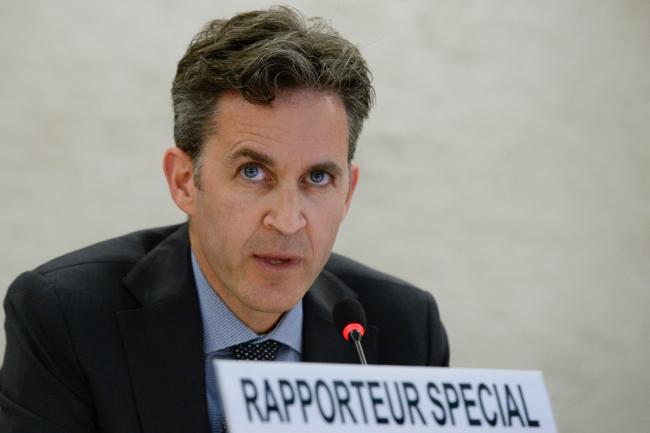
“Countless sources and whistleblowers around the world are intimidated by officials, co-workers, and others, depriving everyone of information that may be critical to public debate and accountability,” David Kaye, the UN Special Rapporteur on the promotion and protection of the right to freedom of opinion and expression told UN General Assembly during the presentation of his study.
“All too often, those revealing allegations of wrongdoing lack effective protection,” the human rights expert warned delegates in the Assembly’s Third Committee – the Organization’s main body dealing with social, humanitarian and cultural issues.
He added, “Silence is too often the only safe option left to them, with the public left in the dark and wrongdoing left unpunished.”
In the first major UN report devoted to the subject, Kaye reviews national and international norms and practices and presents recommendations to establish or improve available protections.
“The problem of source protection extends beyond traditional journalists to bloggers, citizen reporters, [non-governmental organization] researchers, authors, academics, and many others,” the expert noted. “How can they carry out investigative work if they cannot extend the basic assurances of confidentiality to their sources?”
“While there are major gaps in protections, there are also important advancements in norms protecting sources and whistleblowers around the world. Yet they are often riven with loopholes or, even with strong legal protections, not enforced in practice,” he continued.
According to the Office of the UN High Commissioner for Human Rights (OHCHR), the study also emphasizes that the right of access to information – central to Article 19 of the Universal Declaration of Human Rights – requires that authorities take into account the public interest of information disclosed when adopting measures against unauthorized disclosures.
“States may restrict access to information in specific areas and narrow circumstances, yet the disclosure of information relating to human rights or humanitarian law violations should never be the basis of penalties of any kind,” Kaye underscored.
The study notes that the UN and other international organizations also frequently fail to protect their own whistleblowers. “The UN, as most international organizations, has adopted rules for enabling whistleblowing and prohibiting retaliation. Yet allegations of wrongdoing and retaliation are rarely protected effectively,” the human rights expert noted.
“Without protection against retaliation, few would disclose wrongdoing. Protections should be detailed explicitly in law, providing clarity for whistleblowers and others on the nature of the protection they may seek,” the Special Rapporteur said, calling upon Governments and international organizations to strengthen protection mechanisms for sources and whistleblowers.
Special Rapporteurs are part of what is known as the Special Procedures of the Human Rights Council, an independent fact-finding and monitoring mechanism that addresses specific country situations. They do not receive a salary for their work and are independent from any government.
UN Photo/Jean-Marc Ferré
Support Our Journalism
We cannot do without you.. your contribution supports unbiased journalism
IBNS is not driven by any ism- not wokeism, not racism, not skewed secularism, not hyper right-wing or left liberal ideals, nor by any hardline religious beliefs or hyper nationalism. We want to serve you good old objective news, as they are. We do not judge or preach. We let people decide for themselves. We only try to present factual and well-sourced news.
Support objective journalism for a small contribution.


