


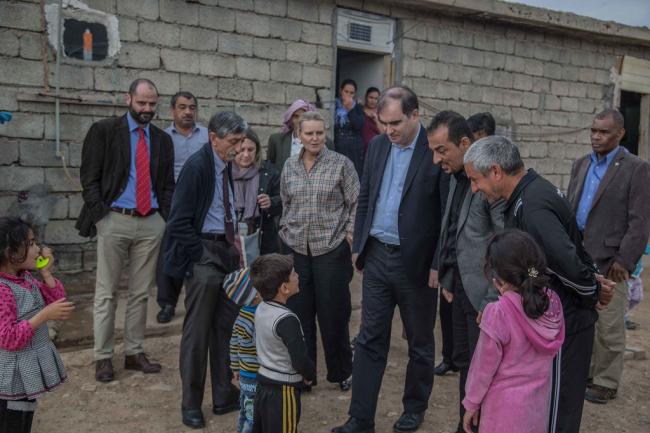
Senior UN official warns of dire consequences for millions of Iraqis due to funding shortfalls
“As the conflict expands and grows more complex, millions of people in Iraq are in increasingly dire need for international assistance," warned John Ging, the Director of Operations of the UN Office for the Coordination of Humanitarian Affairs (OCHA).
According to the UN, two years of instability and insecurity have had a devastating effect on all aspects of life in Iraq. Iraqi people continue to face immense humanitarian challenges, including widespread displacement, the destruction of homes and livelihoods, and difficulty in accessing humanitarian assistance. Over 3.3 million people have been displaced by violent conflict since January 2014.
Ging also highlighted that Iraq is among the most deadly countries in the world for civilians, with thousands injured and killed by explosive weapons and other conflict-related methods each year. Last year, more than 7,500 people were killed and nearly 15,000 were injured in acts of terrorism, violence and armed conflict.
In Baghdad, Ging visited the Takia site for internally displaced persons (IDP) and met with families forced from their homes, most from Anbar and Salah al-Din governorates. Among those he met were a class of teenage girls from Ramadi whose families fled the Islamic State of Iraq and the Levant (ISIL) in April last year.
“I was struck by the enormous courage and positive energy of these girls who have endured such trauma and yet are so inspiring in their commitment to their studies with such a strong belief in a better future," he said.
In Erbil, Ging met with displaced families that had fled violence in Mosul, the Ninewa Plains and Sinjar and are now living in informal sites, including a former chicken farm.
In meetings with officials from both the Government of Iraq and the Kurdistan Regional Government, Ging complimented them for their generosity. "Communities across Iraq have shown exemplary solidarity with the displaced. The Kurdistan Region alone is hosting more than one million displaced people. However, they have limited resources which are nearing exhaustion. More funding is urgently required from the international community - otherwise people are facing a disaster".
The UN official also complimented humanitarian organizations for their outstanding work under the leadership of Lise Grande, the Humanitarian Coordinator in the country. "Iraq is one of the most complex and dangerous environments for aid workers and their courage and dedication is truly inspiring," he said.
Thanking donors for their generosity, Ging made an urgent appeal for additional funding for life saving supplies and medicine. The Humanitarian Response Plan for 2016 prepared by the UN and its partners is a highly-prioritized appeal. Despite this, there is a $731 million shortfall in the current response plan, which is only 15 per cent funded.
Meanwhile, he reminded parties involved in military operations to ensure the protection of civilians and the preservation of civilian infrastructure in accordance with international humanitarian law. "The protection of innocent civilians must be top priority not just in rhetoric, but most importantly in action," he said.
Photo: OCHA/Bahaa Elias
Support Our Journalism
We cannot do without you.. your contribution supports unbiased journalism
IBNS is not driven by any ism- not wokeism, not racism, not skewed secularism, not hyper right-wing or left liberal ideals, nor by any hardline religious beliefs or hyper nationalism. We want to serve you good old objective news, as they are. We do not judge or preach. We let people decide for themselves. We only try to present factual and well-sourced news.
Support objective journalism for a small contribution.


