


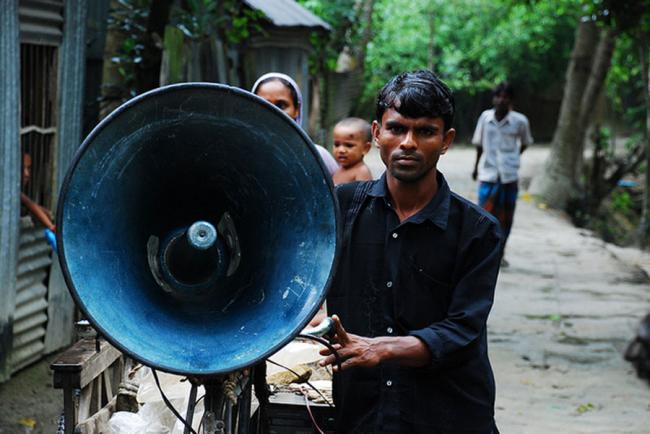
Sendai: Early warning saves lives, but communities need targeted
Throughout several events at the Third World Conference on Disaster Risk Reduction, running in Sendai through Wednesday 18 March, UN experts, Government and civil society officials spotlighted the essential need for effective early warning systems to raise risk awareness, ensure proactive preventive action to help communities reduce, if not prevent, loss of lives and property.
The Executive Secretary of the UN Educational, Scientific and Cultural Organization (UNESCO) Intergovernmental Ocean Committee, Vladimir Ryabinin, said that early warning set-ups had to provide information that is usable and used.
“Even the most advanced systems in the world are useless if people do not respond to the warning,” Ryabinin told participants at the Conference's 'Lessons from Mega-Disasters' session.
He added, “People need to know what to do in the event of a tsunami. We need to educate people. Japan provides an excellent example in this.”
The Director-General of the Japan Meteorological Agency, Noritake Nishide, expanded on the Japanese approach and how early warning had improved since the 2011 earthquake that heavily impacted Sendai and surrounding areas.
More accurate seismology monitors have been installed, key partnerships have been strengthened, and better communication of key information to at-risk populations has been established.
Three factors have been crucial to this better preparedness: first, the issuing of daily earthquake information sensitizes and increases the awareness of the population; second, holding regular disaster scenarios – including real-time evaluations – to increase preparedness; and third, greater adoption of a multi-hazard approach to disaster resilience.
Experience from Chile after the country's massive earthquake in February 2010 had also revealed the need for a more resilient communications system and better links with technical agencies.
The Deputy Director of Chile's Port Works Division Ministry of Public Works, Eduardo Mesina, said these were two of the biggest priority areas identified.
The World Meteorological Organization (WMO) also announced today plans to support governments and others in developing multi-hazard early warning systems that provide a coordinated platform for managing multiple risks.
“Fortunately we have the knowledge and tools we need to prepare for and reduce these risks. Effective disaster response requires political leadership to ensure investments in preparedness and prevention combined with weather forecasts, warnings, media reports, emergency response, health facilities, and recovery plans,” said Michel Jarraud, WMO Secretary-General.
WMO is also working with its Members to develop “impact-based warnings” that describe a predicted event's physical impacts and recommend specific precautionary actions.
One of the world's first multi-hazard early warning systems has been established in Shanghai, a mega city of over 23 million people. This systems delivers alerts on tropical cyclones, storm surges, and extreme temperatures, as well as on floods, diseases, physical damage and other resulting impacts.
Photo: UNISDR/Amir Jina
Support Our Journalism
We cannot do without you.. your contribution supports unbiased journalism
IBNS is not driven by any ism- not wokeism, not racism, not skewed secularism, not hyper right-wing or left liberal ideals, nor by any hardline religious beliefs or hyper nationalism. We want to serve you good old objective news, as they are. We do not judge or preach. We let people decide for themselves. We only try to present factual and well-sourced news.
Support objective journalism for a small contribution.


