


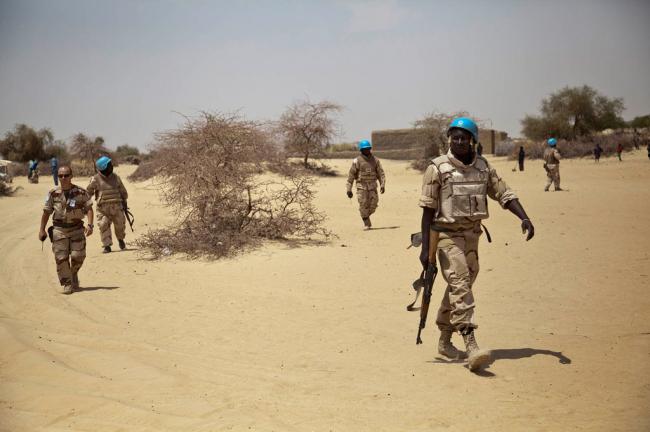
Security Council: UN troop commanders recount challenges of modern peacekeeping
Opening the Security Council’s meeting on protection of civilians, operational threats and performance, held earlier today at UN Headquarters in New York, Under-Secretary-General for UN Peacekeeping Operations Hervé Ladsous, introduced the force commanders of three UN operations – the UN Mission in South Sudan (UNMISS); the Multidimensional Integrated Stabilization Mission in Mali (MINUSMA); and the UN Truce Supervision Organisation (UNTSO) – observing that each of them had a story of courage and determination to tell.
At the same time, he said, the three UN military officials could also relate the growing challenges they and their peacekeepers were facing in the diverse environments across the globe to which they were deployed, particularly due to the unprecedented scale of difficulties they now faced in protecting civilians, observing the caveats imposed by troop-contributing countries, and dealing with asymmetric threats.
Detailing the most pressing aspects of peacekeeping in South Sudan, where an intensifying crisis has forced over 2 million people into internal displacement and plunged an estimated 4.6 million people into severe food insecurity, UNMISS Force Commander, Lieutenant-General Yohannes Gebremeskel Tesfamariam, told Council Members that protection of civilians was not just about ensuring security but also guaranteeing the freedom of movement for people.
“The ability to move and proactively protect civilians in their areas of origin, securing their traditional movement and enabling them to undertake their livelihoods, must be a focus of our efforts in implementing the protection of civilians mandate,” he explained.
Throughout the African country, more than 140,000 people are currently sheltering at UNMISS bases where they seek safety and humanitarian relief from South Sudan’s two-year conflict.
Lieutenant-General Tesfamariam warned, however, that the UN civilian protection sites have increasingly become targets in the fighting with a recent incident, dated between 19 and 21 May, seeing more than 20 artillery shells and stray bullets hit the UNMISS base in Melut, in the country’s northeast.
This and other similar security threats had contributed to increasingly stretching the Mission’s operational abilities.
“It is well understood that protection of civilians is the most resource consuming operation. It requires logistical, financial and human resources, resources that fit the mandate, expectations and realities on the ground,” he continued.
He added, “The limitations that we face in this respect, particularly the absence of critical enablers, such as close-air support, adequate logistics, intelligence, reconnaissance, and responsive CASEVAC/MEDEVAC capabilities, negatively impact our early warning.”
The appeal for more wide-ranging and better equipment was echoed by Major General Michael Lollesgaard, the Force Commander for MINUSMA in Mali, where UN troops are currently operating in one of the more hazardous regions for peacekeeping. MINUSMA forces have frequently been targeted by armed groups operating throughout the vast country with recent attacks in late April resulting in numerous casualties.
“We need to be fully capable of facing this environment in all aspects,” the Major General declared. “That means capability to face hostile armed groups hiding amongst the population and to face challenging climates, geography and infrastructure.”
In order to do that, he said, UN peacekeepers must be properly trained prior to deployment; properly equipped; assisted with robust logistics; and furnished with “well-protected camps with good living conditions,” among other things.
“I know this sounds like a lot,” he acknowledged, “but this is what we need if we want to be able to survive in an asymmetric environment.”
The challenges facing peacekeepers stretch, however, beyond their immediate operational needs and also involve distinct political obstacles, added Major General Michael Finn, Chief of Staff at UNTSO – the first ever peacekeeping operation established by the UN – who highlighted the imposition of national caveats as a “significant restriction” on multinational operations around the world.
Caveats, the Major General affirmed, remain a serious impediment to the command and performance of all UN missions and ultimately restrict a commanders’ ability to exercise command and control in theatres of operation, potentially compromising the ability of ‘blue helmets’ to effectuate their tasks.
“I fully recognize the national interests that drive caveats, but I also see that caveats threaten to ‘drive a wedge’ between contributing nations, threatening as well peacekeeping and observer capabilities of the UN,” he noted.
“Thus, it is a critical challenge to find ways to address the contentious issue of caveats and to maintain the integrity of peacekeeping missions into the future.”
Photo MINUSMA/Marco Dormino
Support Our Journalism
We cannot do without you.. your contribution supports unbiased journalism
IBNS is not driven by any ism- not wokeism, not racism, not skewed secularism, not hyper right-wing or left liberal ideals, nor by any hardline religious beliefs or hyper nationalism. We want to serve you good old objective news, as they are. We do not judge or preach. We let people decide for themselves. We only try to present factual and well-sourced news.
Support objective journalism for a small contribution.


